The Federal
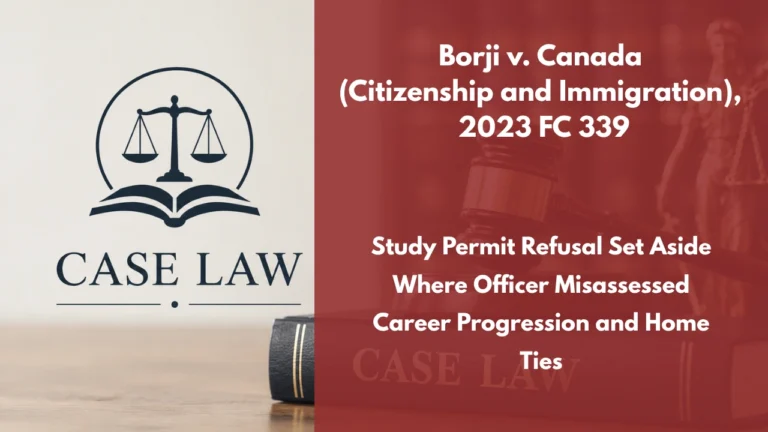
Court reviewed the refusal of Abolfazl Borji’s study permit application for an
MBA at University Canada West. The officer questioned his family ties,
establishment, career progression, and the benefit of further studies. The
Court found several conclusions unsupported by the record, particularly given
the applicant’s lengthy banking career, approved leave of absence, and logical
progression from undergraduate business studies to an MBA.
Key
Principle
An officer cannot treat being single, mobile, or without dependants as
a standalone negative factor in a study permit application without additional
individualized analysis. Where an applicant has substantial employment history,
continuing career ties, and a proposed graduate degree that logically builds on
prior education and experience, the officer must explain why those
circumstances nevertheless fail to support temporary intent or reasonable study
progression.
Background
The
applicant was 38 years old and had an associate degree in accounting and
business, a bachelor’s degree in accounting, and approximately 16 years of
employment with an Iranian bank. He had progressed from teller to Inspector and
sought an MBA to advance his career. He had prepaid tuition, received a
university grant, and had significant additional savings for his studies.
Court
Findings
• Being
Single and Without Dependants Required Further Analysis
The officer
relied on the applicant being single, mobile, and without dependants. The Court
emphasized that these characteristics are shared by many study permit
applicants and cannot reasonably operate as standalone grounds for refusal.
Additional individualized considerations must explain why those characteristics
indicate a particular risk of remaining in Canada.
• Finding
That Applicant Was Not Well Established Was Unreasonable
The
applicant had a lengthy academic and professional history, approximately 16
years with the same bank, a senior position as Inspector, pension
contributions, and family responsibilities involving his mother and siblings.
The Court found the conclusion that he was not well established unintelligible
and inconsistent with the undisputed evidence.
• MBA Was a
Logical Progression From Prior Education and Experience
The officer
concluded that the applicant may already have obtained the benefits of an MBA
through his accounting education and banking career. The Court rejected this
reasoning, noting that an MBA is a higher-level qualification and that pursuing
one after undergraduate study and substantial work experience is a logical
academic and professional progression.
• Officer
Overlooked Approved Leave of Absence
The officer
stated that the applicant had not explained how he would retain his previous
career. In fact, his employer had granted him a two-year leave of absence,
directly demonstrating how he intended to preserve his employment while
studying abroad. The Court found that this evidence had been overlooked or
improperly assessed.
• Promotion
Requirement Set the Evidentiary Bar Too High
The officer
also criticized the applicant for failing to demonstrate that the MBA would
lead to increased promotion prospects. The Court found this expectation
excessive. An applicant need not provide a guaranteed promotion to establish
that graduate business studies may improve future career prospects.
• Overall
Study-Progression Finding Could Not Stand
Because the
officer’s conclusions about career retention, advancement, establishment, and
educational progression were unsupported or inadequately explained, the overall
determination that the proposed studies were unreasonable lacked justification.
Outcome
The Federal
Court granted judicial review, set aside the study permit refusal, and remitted
the matter to a different decision-maker for redetermination. No question was
certified and no costs were ordered.
Case
Citation:
Borji v. Canada (Citizenship and Immigration), 2023 FC 339 (CanLII)
Prepared by:
Dr. Muhammad
Abrar (Barrister and
Solicitor)
Author | Writer | Mentor | Legal Researcher | Canadian Immigration Case Law and
Statistics Analyst