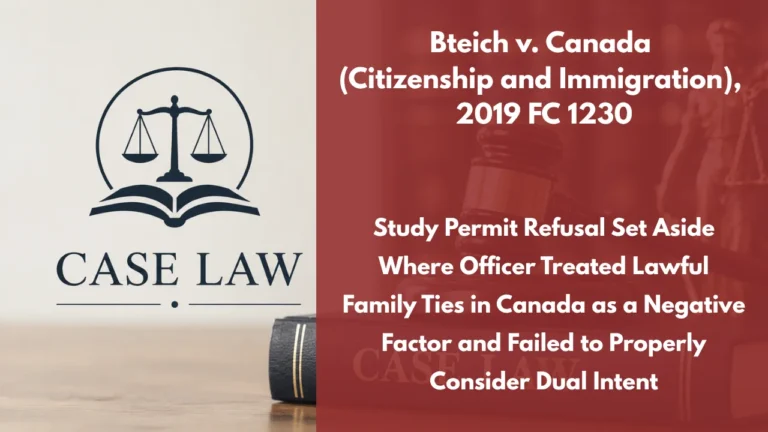
The Federal Court reviewed the refusal of a study permit
application from a young Lebanese applicant whose parents held Canadian work
permits and whose three sisters were studying in Quebec.
The officer relied partly on those strong family ties in
Canada to conclude that the applicant might not leave at the end of his
authorized stay.
The Court found that reasoning unreasonable. Family members
who are lawfully established in Canada do not, without more, support an
inference that an applicant will remain illegally. The officer also failed to
meaningfully consider the applicant’s lawful possibility of dual intent under subsection 22(2) of IRPA.
Key Principle
Canadian immigration law expressly recognizes dual intent.
An applicant may have a future intention to become a permanent resident while
still qualifying as a temporary resident, provided the officer is satisfied
that the applicant will leave Canada if required at the end of the authorized
stay.
Strong family ties in Canada cannot automatically be treated
as evidence of non-compliance.
Where relatives are legally established and financially
supporting the applicant, those circumstances may even be positive factors. At
minimum, an officer must explain why lawful family ties create a genuine
concern that the applicant will remain in Canada without authorization.
Background
The applicant was a 19-year-old Lebanese citizen. His
parents held valid Canadian work permits, and his three sisters were studying
in Quebec.
He was admitted to the University of Montréal as an
independent student and obtained a Quebec Acceptance Certificate.
The visa officer refused the study permit based on family
ties, purpose of visit, the absence of an explanation for choosing studies in
Canada, and concerns regarding whether the applicant was a bona fide student
who would leave Canada after his studies.
Court Findings
The Court rejected the officer’s treatment of the
applicant’s family ties.
The fact that the applicant’s immediate family members were
legally residing in Canada did not reasonably establish that he would remain
unlawfully after the expiry of his status. The Court noted that the family’s
lawful status and ability to financially support him could instead weigh
positively in the assessment.
The officer was required to provide some rational
explanation connecting the Canadian family ties to a likelihood of future
immigration non-compliance. None was provided.
The Court also emphasized subsection 22(2) of IRPA. The
possibility that the applicant may ultimately wish to remain permanently in
Canada was not inconsistent with temporary resident status. His potential dual
intent was lawful and had to be assessed accordingly.
The officer was also concerned that the applicant had not
adequately explained his choice of Canadian studies. However, the Court found
that the officer’s concerns regarding his educational plans and intentions
should have prompted further inquiry rather than unsupported conclusions.
The Court observed that giving the applicant an opportunity
to respond could have addressed key concerns surrounding both his educational
choices and his intentions.
The broader problem was that the refusal rested on
assumptions rather than sufficiently articulated reasoning. An officer may rely
on common sense, but a decision cannot rest merely on intuition or a hunch. The
reasons must explain why the evidence supports the conclusion reached.
Outcome
The Federal Court allowed the application for judicial
review and remitted the study permit application to a different officer for
redetermination, with the applicant’s family circumstances and lawful dual
intent to be properly considered.
Case
Citation:
Bteich v. Canada (Citizenship and Immigration), 2019 FC 1230 CanLII
Prepared by:
Dr. Muhammad
Abrar (Barrister and
Solicitor)
Author | Writer | Mentor | Legal Researcher | Canadian Immigration Case Law and
Statistics Analyst