Introduction
The Federal Court
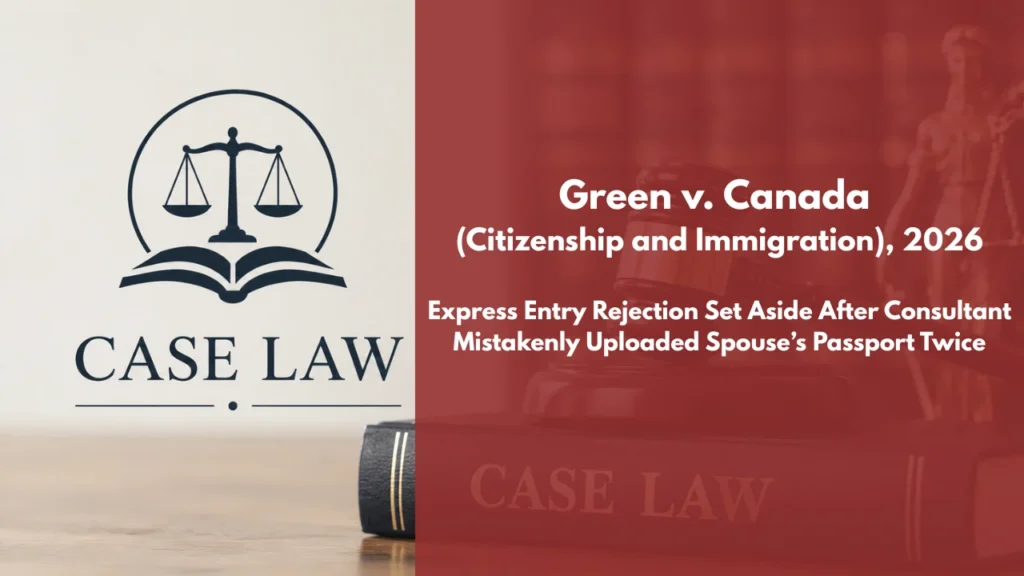
reviewed IRCC’s rejection of a permanent residence application submitted under
Express Entry. The application was rejected as incomplete because the
applicant’s passport had not been included. The missing document resulted from
the applicant’s immigration consultant accidentally uploading a second copy of
the spouse’s passport instead of the applicant’s own passport. The Court found
that this error amounted to ineffective assistance and deprived the applicant
of procedural fairness.
Key Principle
The Federal Court
reaffirmed that ineffective assistance of counsel or a representative may
constitute a breach of procedural fairness where the representative’s conduct
amounts to incompetence, the error caused a miscarriage of justice, and the
representative was given notice and an opportunity to respond. An obvious
filing error that causes an application to be rejected may meet this test.
Background
The applicant, a
citizen of Israel, had been living and working in Edmonton on a work permit.
After being nominated by Alberta under the Provincial Nominee Program, he
applied for permanent residence through Express Entry for himself, his spouse,
and their dependents.
IRCC rejected the
application because it did not include a copy of the applicant’s passport or
travel document. The applicant’s consultant later admitted that he had all
required documents but mistakenly uploaded the spouse’s passport twice. The
consultant accepted full responsibility and confirmed that, but for this error,
the application would have been properly submitted.
Court Findings
• Consultant’s
Error Amounted to Incompetence
The Court held
that the consultant’s failure to submit the correct passport was not a matter
of reasonable professional judgment. It was an obvious and indisputable error
that caused the application to fail. Although courts presume that
representatives act within a range of reasonable professional assistance, that
presumption was rebutted in this case.
• Error Caused
a Miscarriage of Justice
The Court found
that the applicant met the second branch of the ineffective assistance test.
Had the consultant submitted the passport, the application would not have been
rejected as incomplete and would have proceeded to processing. There was
therefore a reasonable probability that the result would have been different.
• Alternative
Remedy Did Not Defeat Judicial Review
The Respondent
argued that the applicant could have simply submitted a new application with
the passport included. While the Court acknowledged that refiling may have been
faster and more efficient, it held that this did not erase the breach of
procedural fairness caused by the consultant’s incompetence.
Outcome
The Federal Court
granted the application for judicial review, set aside IRCC’s November 19, 2024
decision, and returned the matter for redetermination by a different officer.
The applicant was also given an opportunity to update the application before a
new decision was made. No question was certified.
Case Citation: Green
v. Canada (Citizenship and Immigration), 2026 FC 315 (CanLII)
Prepared by:
Dr. Muhammad Abrar (Barrister and Solicitor)
Author | Writer | Mentor | Legal Researcher | Canadian Immigration Case Law and Statistics Analyst