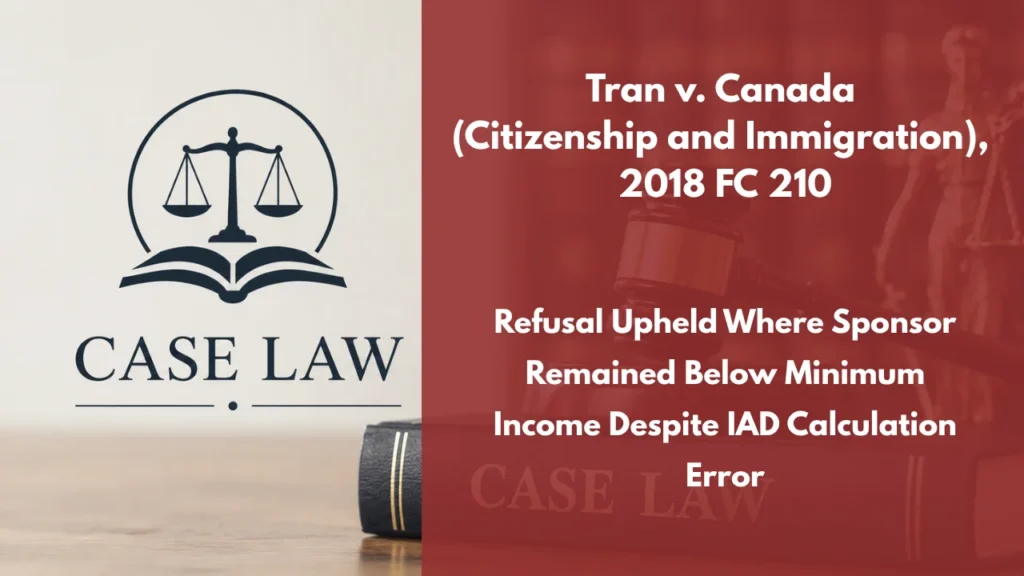
The Federal Court reviewed an
Immigration Appeal Division decision dismissing Thi Van Tuong Tran’s appeal
from the refusal of her application to sponsor her mother for permanent
residence. Ms. Tran acknowledged that her income was below the minimum necessary
income but sought humanitarian and compassionate relief. Although the Court
found that the IAD incorrectly assessed her 2016 income, the error did not
affect the outcome because a shortfall remained and the IAD reasonably assessed
the H&C considerations.
Key Principle
An error in an IAD decision does
not necessarily make the decision unreasonable where correcting the error would
not have changed the outcome. In a family sponsorship case involving the
minimum necessary income requirement, H&C relief remains discretionary.
Ordinary consequences of family members living in different countries, without
additional compelling circumstances, do not necessarily justify special relief,
and employment insurance benefits excluded from the statutory income
calculation cannot effectively be restored through an H&C analysis merely
because the sponsor works seasonally.
Background
Ms. Tran, a Vietnamese citizen
and permanent resident, and her husband worked seasonally in British Columbia’s
fishing industry. In 2009, they applied to sponsor Ms. Tran’s mother and three
siblings.
The sponsorship application was
refused in 2016 because Ms. Tran did not satisfy the MNI requirement. She
appealed to the IAD but requested H&C relief.
The IAD estimated the family’s
income shortfall at $22,000. It also questioned Ms. Tran’s credibility
concerning her earnings. While giving positive weight to her establishment, the
IAD found insufficient hardship and concluded that the best interests of her
12-year-old son were not a significant factor warranting relief.
Court Findings
• IAD Miscalculated the
Sponsor’s Income
The IAD believed Ms. Tran had
inflated her expected 2016 employment income from $27,000 to $36,000. The Court
found that this conclusion resulted from misunderstanding her paystubs. She
earned $3,000 every two weeks, not monthly, and worked from July through
December. There was therefore no inconsistency supporting the adverse
credibility finding. However, even using $36,000, the MNI shortfall remained
$15,000, which was significant.
• Best Interests of the Child
Were Reasonably Considered
The Court rejected the argument
that the IAD inadequately considered Ms. Tran’s son. The child was not facing
separation from a parent or relocation to an unfamiliar country. The benefit
was contact between grandmother and grandson. The Court held that this type of
separation is common in family reunification cases and, without more, did not
require H&C relief.
• Seasonal Employment Did Not
Justify Counting EI Benefits
Ms. Tran argued that employment
insurance benefits should support her H&C case because seasonal fishing
employment naturally involved periods of EI. The Court noted that the
Regulations exclude EI payments when calculating sponsorship income. Treating
those benefits differently through H&C relief would create an exception to
that policy choice.
Outcome
The Federal Court dismissed
judicial review. The IAD erred in calculating Ms. Tran’s income and the MNI
shortfall, but correcting that error would not have changed the result. The
shortfall was significant, and the IAD reasonably found the H&C factors
insufficient. No question was certified.
Case
Citation:
Tran v. Canada (Citizenship and Immigration), 2018 FC 210 (CanLII)
Prepared by:
Dr. Muhammad Abrar (Barrister and Solicitor)
Author | Writer | Mentor | Legal Researcher | Canadian Immigration Case Law and Statistics Analyst