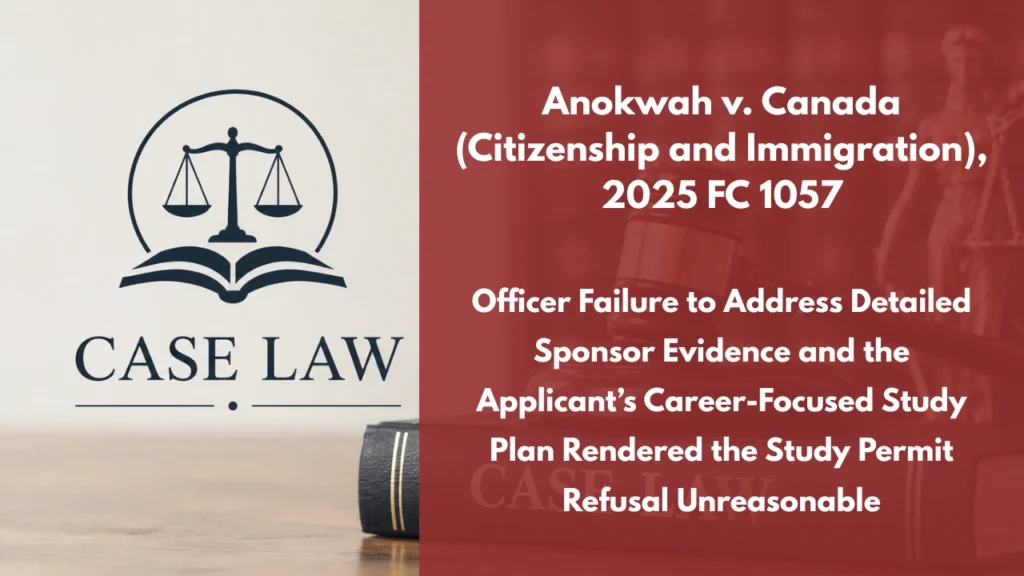
The Federal Court reviewed IRCC’s
refusal of Sheila Anokwah’s study permit and co-op work permit applications.
The Ghanaian applicant sought to study Software Development at the Southern
Alberta Institute of Technology. The officer found that her proposed studies
were unreasonable in light of her previous education and that her financial
evidence was insufficient because her relationship with her sponsoring cousin
was not adequately established. The Court granted judicial review because the
reasons did not meaningfully address the applicant’s detailed evidence
concerning either her financial sponsorship or her choice of program.
Key Principle
A visa officer’s reasons may be
brief, but they must provide responsive justification on the central issues
raised by the application. Where a financial sponsor submits a sworn
declaration explaining the family relationship, the reason for offering support,
and the availability of substantial funds, an officer cannot simply state that
the relationship or sponsorship is insufficiently documented without explaining
why that evidence was inadequate. Similarly, a detailed study plan cannot
reasonably be dismissed through a generic conclusion that does not engage with
the applicant’s education, career history, and reasons for selecting the
program.
Background
The applicant was accepted into a
Software Development program that included co-op work placements.
She submitted evidence showing
more than CAD $102,000 in available funds and receipts confirming that she had
already paid CAD $4,600 toward tuition.
Her cousin agreed to finance her
studies. He provided bank statements, a sworn statutory declaration, and an
explanatory letter confirming his commitment.
The cousin stated that he had no
dependants and wished to support the applicant because, when she was 15 years
old, she had saved his life after he fell into a deep pit.
The officer found that the
relationship between the applicant and the funding source was not sufficiently
substantiated and that there was inadequate evidence of prior funding or
ongoing full sponsorship.
The officer also concluded that
the applicant’s motivation to study software development was unreasonable given
her previous educational history.
Court Findings
• Sponsorship Evidence Was Not Meaningfully Addressed
The Court found that the officer failed to engage with the cousin’s statutory
declaration and explanatory letter, both of which directly explained the family
relationship and the commitment to finance the applicant’s studies. Ignoring
this central evidence rendered the financial assessment unreasonable.
• Bare Conclusion Was Insufficient
The Court held that it was not enough for the officer to simply state that the
relationship with the financial sponsor was inadequately established. At a
minimum, the officer was required to explain why the sworn declaration and
supporting evidence did not satisfactorily prove the relationship.
• Visa Office Instructions Could Not Supplement the
Reasons
The Minister argued that visa office instructions required additional
documents, such as birth certificates, to establish the relationship. The Court
rejected this justification because it was unclear whether those instructions
applied at the relevant time, and more importantly, the officer had not relied
on them in the decision.
• Study Plan Was Detailed and Specific
The Court found that the applicant had provided a detailed explanation of her
educational background, career goals, and reasons for choosing a software
development program with co-op experience. The officer’s generic conclusion
failed to meaningfully engage with this evidence or explain why the study plan
was unreasonable.
• Court Could Not Construct Better Reasons
The Court emphasized that neither the Minister nor the Court could supplement
the officer’s inadequate reasoning after the fact. Because the refusal failed
to provide responsive justification on the two central issues—the financial
sponsorship and the study plan—the decision was unreasonable and had to be set
aside.
Outcome
The Federal Court granted
judicial review, set aside the refusal, and returned the applications to a
different officer for reconsideration. The applicant was permitted to submit
additional information. No question was certified.
Case Citation:
Anokwah v. Canada (Citizenship and Immigration), 2025 FC 1057 (CanLII)
Prepared by:
Dr. Muhammad
Abrar (Barrister and
Solicitor)
Author | Writer | Mentor | Legal Researcher | Canadian
Immigration Case Law and Statistics Analyst