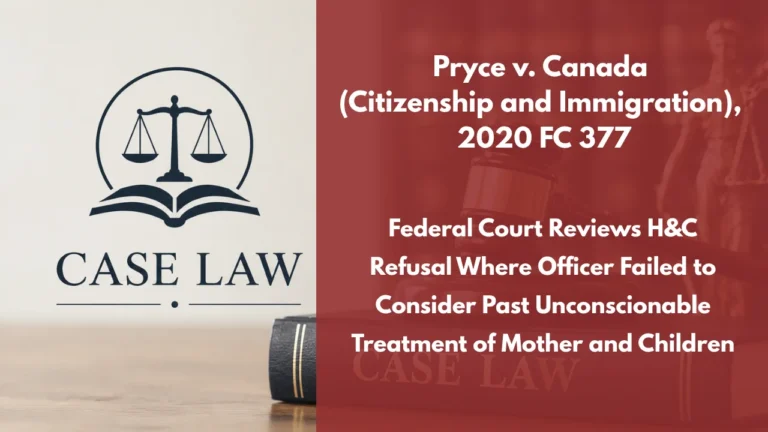
Ashley Nadine Laing Nee Pryce
sought judicial review of an officer’s refusal of her application for permanent
residence from within Canada on humanitarian and compassionate grounds under
section 25(1) of the Immigration and Refugee Protection Act. Her application
relied principally on the best interests of her three children and hardship
upon return to Jamaica. Although the Court upheld most of the officer’s
hardship and BIOC analysis, it found the decision unreasonable because the
officer failed to consider the family’s past shocking and unconscionable
treatment as a distinct compassionate factor.
Key Principle
Past hardship may be relevant to
an H&C application even where it will not recur upon removal and is not
specifically listed in the H&C Guidelines. Section 25(1) requires a
compassionate and holistic assessment consistent with Kanthasamy and Chirwa.
Where evidence of past unconscionable mistreatment is sufficiently compelling,
an officer may be required to consider whether that suffering itself, or
together with other factors, warrants special relief.
Background
Pryce, a Jamaican citizen,
married a Canadian citizen and had three children, all dual Canadian-Jamaican
citizens. The family had worked in Christian ministry in Jamaica. In 2016, her
husband persuaded the family to travel to Israel with a young woman involved in
the ministry. Three days after arriving, he revealed an affair with the woman,
abandoned Pryce and their children, and returned with the woman to Canada.
Pryce and the children eventually
came to Canada, where they developed close relationships with the children’s
father and paternal grandparents. Pryce argued that returning to Jamaica would
cause hardship because of limited employment prospects, weak family support,
poverty, violence, and the impact on the children.
The officer refused H&C
relief, finding insufficient evidence that Pryce could not return to ministry
employment or obtain support in Jamaica, and concluding that the children’s
interests did not justify an exemption.
Court Findings
• Most Hardship and BIOC
Findings Were Reasonable
The Court found no reviewable
error in the officer’s assessment of employment prospects, country conditions,
state protection, the father’s involvement, or the children’s relationships.
The evidence permitted the officer’s conclusions on these conventional hardship
and BIOC factors.
• Past Unconscionable
Treatment Required Consideration
The decisive error concerned the
family’s abandonment in Israel. The Court characterized the alleged treatment
as shocking and potentially unconscionable. Relying on Kanthasamy, it held that
H&C considerations are not confined to future hardship or factors
identified in administrative Guidelines. The equitable purpose of section 25(1)
required consideration of whether the family’s past suffering could itself
support compassionate relief.
• Officer Must Consider the
Circumstances Holistically
The officer mentioned the
abandonment as background but did not assess it as a compassionate factor. The
Court held that officers must consider relevant facts capable of generating
compassion, particularly compelling evidence involving vulnerable children,
even where the factor is not expressly framed by the applicant.
Outcome
The application was allowed and
returned to the same officer to consider whether the past hardship was
unconscionable and, if so, its significance for H&C relief. The Court also
certified a question concerning consideration of past unconscionable mistreatment
not explicitly raised by an applicant.
Case
Citation:
Pryce v. Canada (Citizenship and Immigration), 2020 FC 377 (CanLII)
Prepared by:
Dr. Muhammad Abrar (Barrister and Solicitor)
Author | Writer | Mentor | Legal Researcher | Canadian Immigration Case Law and Statistics Analyst