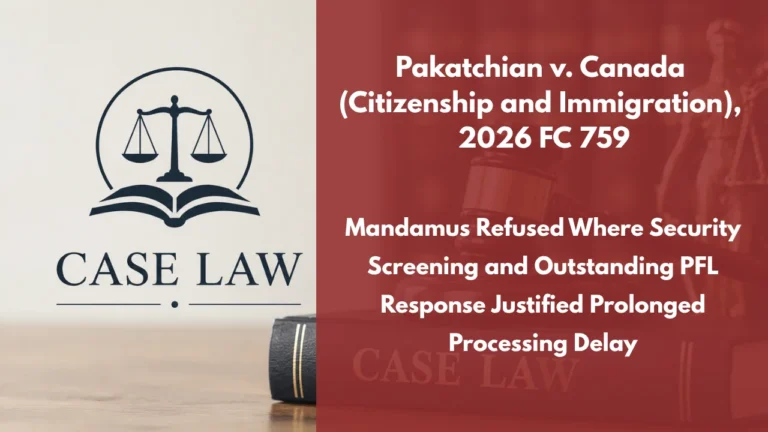
The Federal Court dismissed an
application for mandamus seeking an order compelling IRCC to process a
long-pending study permit application. The Applicant argued that the
approximately four-year delay was unreasonable and that IRCC had breached his
legitimate expectations based on published processing times. The Court found
that the Applicant had failed to satisfy the Apotex requirements for
mandamus, particularly because the application remained subject to security
screening and the Applicant had not responded to a procedural fairness letter
(PFL) addressing serious national security concerns. Pasted text
Key Principle
IRCC processing times do not
create a legal entitlement to a decision within the posted timeframe. Where an
application requires security screening, the reasonableness of the delay is
assessed on the particular facts, and there is no uniform time limit applicable
to security-related processing. An applicant seeking mandamus must establish
both a clear public legal duty to act and a clear right to performance of that
duty. An outstanding PFL response may provide a reasonable justification for
continued processing and defeat a claim of unreasonable delay. Pasted text
Background
The Applicant, an Iranian
citizen, filed an application in February 2022 relating to doctoral studies in
aerospace engineering at Carleton University. IRCC requested additional
information and the application was subsequently referred for security screening.
The Applicant later sought an order requiring IRCC to make a decision within
five days, arguing that the delay was excessive compared with IRCC’s published
processing estimates. Pasted text
In February 2026, IRCC issued a
PFL raising concerns about the Applicant’s work as an axial compressor design
engineer, his employer’s designation under the Special Economic Measures (Iran)
Regulations, and his prior collaboration with an aerospace engineering
professor whose work involved military applications. IRCC expressed concerns
under s 34(1)(d) of the IRPA regarding dual-use technology and potential
implications for Canada’s national security. The Applicant was given 30 days to
respond but did not respond to the PFL or to a subsequent settlement offer.
Pasted text
Court Findings
• Mandamus requirements not
met: Applying the Apotex framework, the Court found that the
Applicant failed to establish both the existence of a clearly defined public
legal duty to decide within the requested timeframe and a clear right to
performance of that duty. Pasted text
• Security screening justified
the delay: The application had been referred for security screening in
April 2022. The Court found that the delay was reasonable in the circumstances
because security screening was required and the record also involved authorized
redactions under s 87 of the IRPA. Published processing estimates did not
include the time required for security clearances. Pasted text
• Failure to respond to PFL
was significant: The Court considered it fatal that the Applicant had not
responded to the PFL despite arguing that the expiry of the response period
required IRCC to make a decision. The PFL was intended to allow the Applicant
to address specific security concerns and provide information necessary for the
assessment. Pasted text
• No legitimate expectation
from processing times: IRCC’s published processing times are non-binding
estimates concerning average applications. They do not constitute clear,
unambiguous and unqualified representations giving an individual applicant a
legal entitlement to a decision within that period. Pasted text
Outcome
The application for mandamus and
declaratory relief was dismissed. The Court found no implied refusal to
act and no unreasonable delay in the circumstances. No costs were awarded, and
the Court noted that damages or monetary compensation are not available as
remedies for judicial review under s 18(1) of the Federal Courts Act. Pasted
text.
Case
Citation:
Pakatchian v. Canada (Citizenship and Immigration), 2026 FC 759 (CanLII)
Prepared by:
Dr. Muhammad
Abrar (Barrister and
Solicitor)
Author | Writer | Mentor | Legal Researcher | Canadian
Immigration Case Law and Statistics Analyst