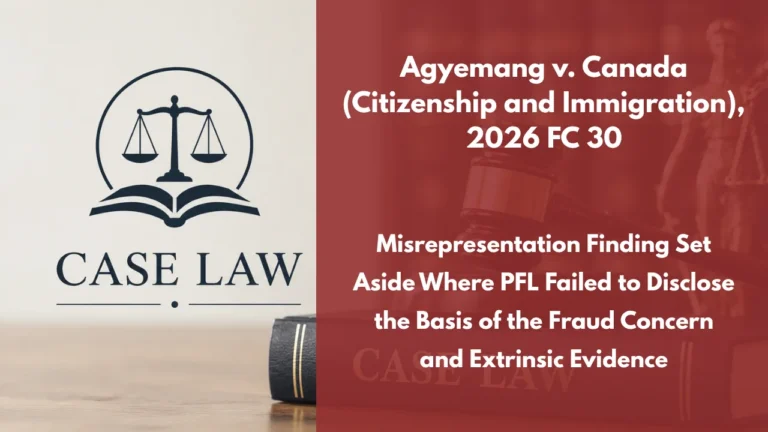
The Federal Court granted
judicial review of a study permit refusal based on inadmissibility for
misrepresentation under s 40(1) of the IRPA. The Court held that
misrepresentation findings attract a high level of procedural fairness,
regardless of the type of underlying immigration application. This required
full disclosure of the Officer’s concerns and of extrinsic evidence giving rise
to those concerns. Pasted text
Key Principle
Where an application is refused
because of s 40(1) misrepresentation, the applicant must be given a meaningful
opportunity to know and respond to the case against them. The Court held that a
PFL must disclose the Officer’s actual concerns reflected in the file notes, as
well as relevant extrinsic evidence that generated those concerns. The Court
rejected the more limited “gist” approach to disclosure in the
misrepresentation context. Pasted text
Background
The Applicant applied for a study
permit to attend Niagara College and submitted a bank statement from her
father’s Prudential Bank account as evidence of financial support. IRCC issued
a PFL expressing concerns about the genuineness of the bank statement and
asking the Applicant to explain how she obtained it and why it was submitted.
Pasted text
The Applicant responded and
provided a letter from a bank operations manager confirming the account, its
opening date and balance. IRCC had independently contacted the bank. The bank
initially stated that it could not confirm the authenticity of the stamp on the
statement and later advised that the statement was “fake” because the signature
and stamp did not originate from the identified branch. None of this extrinsic
evidence was disclosed to the Applicant before the refusal. Pasted text
Court Findings
• High procedural fairness
applies to s 40 findings: The Court applied the Baker factors and concluded
that misrepresentation determinations require a high level of procedural
fairness because of their specific statutory requirements, finality, and severe
consequences, including the five-year prohibition period and stigma associated
with dishonesty. Pasted text Pasted text
• Full disclosure required: The PFL failed to disclose that the bank’s concerns specifically related to the
authenticity of the stamp. The Court held that the Applicant was entitled to
know the Officer’s concerns and the extrinsic evidence that generated them. The
Court expressly rejected applying the “gist” approach as a general standard for
s 40 misrepresentation findings. Pasted text
• Extrinsic evidence must
generally be disclosed: Where information from outside the application
gives rise to specific misrepresentation concerns, it should be disclosed
unless there is a valid justification for withholding it, such as privilege or
national security. Pasted text
• Officer improperly relied on
the bank’s conclusion: The bank’s response was ambiguous as to which
document was “fake.” Nevertheless, the Officer concluded that the Applicant had
submitted two fraudulent documents. The Court found this amounted to
unjustified reliance on extrinsic evidence and an unfair fettering of the
Officer’s discretion. Pasted text
Outcome
The Court found both a procedural
fairness breach and an unreasonable decision. The refusal was set aside and
remitted to a different officer. The new decision maker was directed to allow
updated submissions and to provide full disclosure of any s 40(1) concerns and
disclosable extrinsic evidence, followed by a reasonable opportunity to
respond. Pasted text
Case
Citation:
Agyemang v. Canada (Citizenship and Immigration), 2026 FC 30 (CanLII)
Prepared by:
Dr. Muhammad
Abrar (Barrister and
Solicitor)
Author | Writer | Mentor | Legal Researcher | Canadian
Immigration Case Law and Statistics Analyst