The
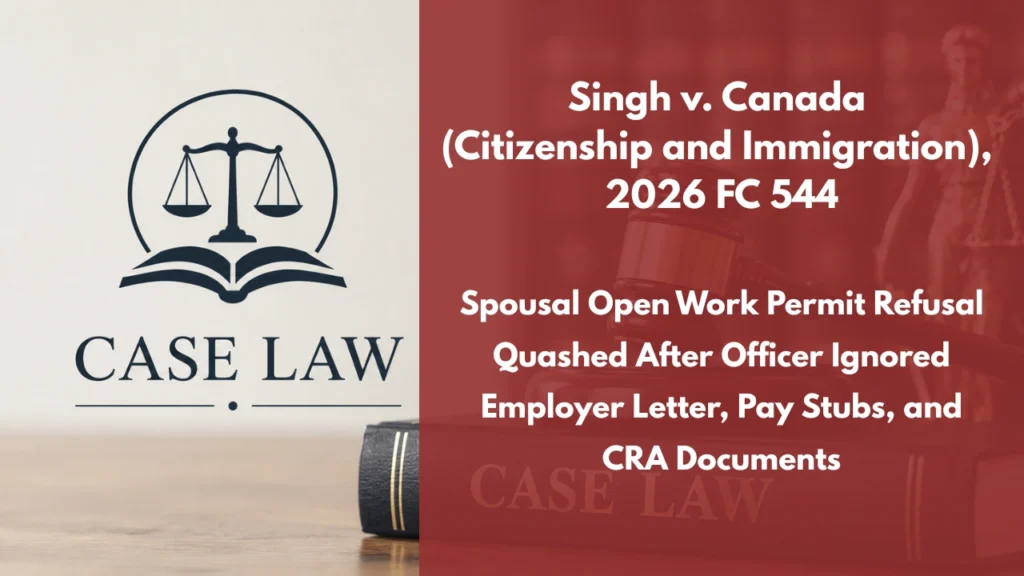
Federal Court allowed an application for judicial review after a visa officer
refused a spousal open work permit under paragraph 205(c)(ii) of the Immigration
and Refugee Protection Regulations (IRPR). The refusal was based solely on
the absence of bank statements showing salary deposits for the applicant’s
spouse, despite extensive documentary evidence establishing her qualifying
employment in Canada. The Court found the decision unreasonable because the
officer ignored compelling evidence, failed to justify why additional bank
statements were necessary, and reached a conclusion that was irrational and
unintelligible.
Key
Principle
When
assessing eligibility for a spousal open work permit under the International
Mobility Program, officers must consider the entire evidentiary record and
provide rational reasons for rejecting material evidence. Administrative
guidelines may assist in interpreting the law but cannot impose mandatory
documentary requirements beyond those found in the IRPA or the IRPR.
A refusal cannot reasonably rest on the absence of a single document where the
remaining evidence clearly establishes that the principal foreign national is
employed in a qualifying TEER occupation.
Background
The
applicant sought a C-41 spousal open work permit based on his wife’s employment
in Canada. His spouse held a valid employer-specific work permit supported by a
Labour Market Impact Assessment and worked as an administrative officer in a
qualifying TEER occupation. The application included her work permit, LMIA,
employer verification letter, affidavit, pay stubs, CRA Notice of Assessment,
T4 statement, and bank account information. Nevertheless, the visa officer
refused the application solely because bank statements showing salary deposits
from the employer had not been provided, concluding that the applicant had
failed to establish his spouse’s current qualifying employment.
Court
Findings
•
Officers Must Meaningfully Assess All Relevant Evidence
The
Court held that the officer overlooked significant evidence directly supporting
the spouse’s employment, including the employer’s verification letter, LMIA,
work permit, pay stubs, T4 statement, and CRA documentation. While officers
have discretion in weighing evidence, they cannot ignore material evidence or
reject an application without explaining why the existing evidence is
insufficient. The officer failed to explain why bank statements were necessary
or why the extensive documentary record did not adequately establish qualifying
employment.
•
Decisions Must Be Justified and Transparent
The
Court emphasized that although visa officers are only required to provide brief
reasons, those reasons must still demonstrate a rational chain of analysis.
Here, the officer failed to explain why the absence of bank statements
outweighed the numerous official employment documents submitted with the
application. Without that explanation, neither the applicant nor the Court
could understand the basis for the refusal.
•
An Irrational Evidentiary Requirement Renders a Decision Unreasonable
The
Court concluded that the refusal lacked basic logic. The documentary evidence
clearly established that the spouse occupied a qualifying TEER position and was
actively employed and remunerated. The Court observed that a T4 statement and
employer-issued pay records already confirmed the employment relationship,
making the insistence on additional bank statements unnecessary. By
disregarding overwhelming evidence in favour of a single missing document, the
officer reached a conclusion that was unintelligible and contrary to common
sense.
Outcome
The
Federal Court allowed the application for judicial review, set aside the
refusal, and remitted the matter to a different visa officer for
redetermination within 30 days. The Court held that the decision was
unreasonable because it ignored compelling evidence, failed to justify the
rejection of that evidence, and imposed an unsupported documentary requirement
not found in the governing legislation or administrative guidelines.
Case
Citation:
Singh v. Canada (Citizenship and Immigration), 2026 FC 544 (CanLII)
Prepared by:
Dr. Muhammad
Abrar (Barrister and
Solicitor)
Author | Writer | Mentor | Legal Researcher | Canadian
Immigration Case Law and Statistics Analyst