Employment
Was Missing
The
Federal Court dismissed an application for judicial review challenging the
refusal of a spousal open work permit under the International Mobility Program.
The applicant argued that the refusal was procedurally unfair because the visa
officer failed to notify her that important supporting documents—her spouse’s
employment letter, pay stubs, and bank records—were missing from her
application. The Court rejected this argument, holding that officers are not
required to alert applicants to deficiencies in their applications or provide
opportunities to supplement missing evidence. Applicants bear the
responsibility of submitting a complete application that satisfies the
statutory requirements from the outset.
Key
Principle
Visa
officers are under no duty to notify applicants that required documents are
missing or to provide an opportunity to correct deficient work permit
applications. Procedural fairness does not require officers to assist
applicants in completing their case where the refusal results from insufficient
evidence rather than concerns about credibility. Applicants must put their best
case forward when submitting their applications.
Background
The
applicant, a citizen of Iran, applied for a spousal open work permit under the
International Mobility Program based on her husband’s employment in Canada.
After
the application was refused, she discovered during the judicial review
proceedings that several documents referenced in her application—including her
spouse’s employment letter, pay stubs, and bank records—had inadvertently been
omitted from the application package. She argued that because the officer knew
documents were intended to accompany the application, procedural fairness
required IRCC to notify her of the omission before refusing the application.
The
officer refused the application after finding that the applicant had failed to
establish her eligibility for a spousal open work permit, including failing to
demonstrate that her spouse was employed in Canada.
Court
Findings
· No Duty to Cure Deficient Applications
Justice
Tsimberis held that the officer’s concerns related to the sufficiency of
the evidence, not its credibility. Since the application simply lacked required
documentation, the duty of procedural fairness was not engaged. The Court
reaffirmed that officers are not required to seek clarification, request
missing documents, or provide applicants with a “running score” of
weaknesses in their applications before rendering a decision.
· Missing Proof of the Spouse’s Employment Was Determinative
The
Court found that the decisive issue was the applicant’s failure to provide
evidence that her spouse was employed in Canada, a mandatory requirement for
eligibility under the Program Delivery Instructions governing spousal open work
permits. Although the officer mistakenly referred to the applicant’s own
“job offer,” that drafting error was not material because the real
basis for refusal was the absence of proof of the spouse’s qualifying Canadian
employment.
· Brief Reasons Were Still Adequate
The
applicant argued that the officer relied largely on template language. The
Court acknowledged that the reasons were brief but concluded they were
sufficient because the GCMS notes specifically identified the missing proof of
the spouse’s employment. This individualized finding explained the officer’s
reasoning and allowed the Court to understand why the application failed.
Outcome
The
Federal Court dismissed the application for judicial review, concluding that
there was no breach of procedural fairness and that the refusal was reasonable.
The decision confirms that applicants seeking spousal open work permits must
ensure that all required supporting documents accompany their application, as
visa officers have no obligation to identify missing evidence or provide
opportunities to correct incomplete applications before rendering a decision.
Case
Citation:
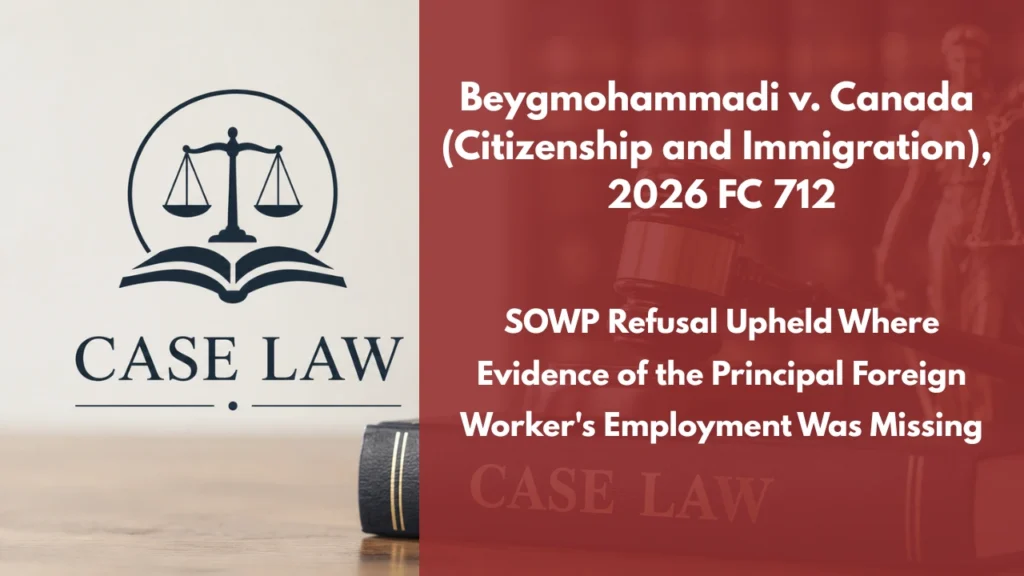
Beygmohammadi v. Canada (Citizenship and Immigration), 2026 FC 712 (CanLII)
Prepared by:
Dr. Muhammad
Abrar (Barrister and
Solicitor)
Author | Writer | Mentor | Legal Researcher | Canadian
Immigration Case Law and Statistics Analyst