The
Federal Court dismissed an application for judicial review of the refusal of an
open work permit under the International Mobility Program. The applicant sought
to join her husband in Canada, who held an open work permit, but the visa
officer refused the application after concluding that no marriage certificate
had been submitted to establish the relationship and that the purpose of the
visit was therefore inconsistent with a temporary stay. On judicial review, the
applicant argued that the marriage certificate had in fact been uploaded with
her application and that the officer ignored it. The Court rejected these
arguments, finding that the applicant failed to prove the document had been
before the officer and that the refusal was therefore both procedurally fair
and reasonable.
Key
Principle
An
applicant who alleges that the decision-maker failed to consider a document
omitted from the Certified Tribunal Record bears the burden of proving that the
document was actually before the officer. A mere assertion that the document
was submitted is insufficient. Where an applicant cannot establish that a
material document formed part of the application, an officer may reasonably
refuse the application on the basis of the evidentiary record before them, and
no breach of procedural fairness arises.
Background
The
applicant, an Iranian citizen, applied for an open work permit in March 2024 to
reunite with her husband, who had previously obtained an open work permit and
was living and working in Canada. The visa officer refused the application
after finding that the applicant had not established she would leave Canada at
the end of her authorized stay and noting that no marriage certificate had been
submitted to establish the claimed relationship with her husband. The applicant
sought judicial review, arguing that the marriage certificate had been included
in the application package and that the officer ignored it. She also argued
that the officer failed to consider her ties to Iran when assessing whether she
would leave Canada at the end of her stay.
Court
Findings
•
The Applicant Bears the Burden of Proving Missing Documents Were Before the
Officer
The
Court reaffirmed that where a document is absent from the Certified Tribunal
Record, the applicant bears the burden of demonstrating that it was
nevertheless before the decision-maker. A bare assertion that a document was
submitted does not satisfy this burden. The applicant relied primarily on screenshots
and an affidavit claiming that a PDF uploaded with the application contained
the marriage certificate. However, the Court found the screenshots
incomplete and insufficiently connected to the application, while the affidavit
did not satisfactorily explain why other documents reproduced in the same
exhibit were also absent from the Certified Tribunal Record.
•
IRCC Records Were More Reliable Than the Applicant’s Evidence
The
Court preferred the evidence of an Immigration, Refugees and Citizenship Canada
officer, whose affidavit reproduced the GCMS records showing the contents of
the applicant’s uploaded document package. Those records demonstrated that only
one document package had been submitted and that no marriage certificate formed
part of it..
•
No Procedural Fairness Breach Occurred
Having
concluded that the marriage certificate was not before the officer, the Court
held there was no procedural unfairness. The officer cannot be faulted for
failing to consider evidence that was never submitted. The Court accepted that
the applicant may have intended to include the marriage certificate, but an
intention to submit evidence is not equivalent to proving that it was actually
uploaded and available to the decision-maker.
•
The Refusal Was Reasonable
Because
the applicant failed to establish her relationship with the principal work
permit holder through documentary evidence, the officer reasonably concluded
that the requirements for the requested open work permit had not been met. The
absence of proof of the marital relationship was sufficient to justify the
refusal, making it unnecessary for the Court to consider the applicant’s
remaining arguments regarding her ties to Iran.
Outcome
The
Federal Court dismissed the application for judicial review. It held that the
applicant failed to establish that her marriage certificate was before the visa
officer, there was no breach of procedural fairness, and the refusal of the
open work permit application was reasonable because the applicant had not
established the qualifying spousal relationship.
Top of Form
Case
Citation:
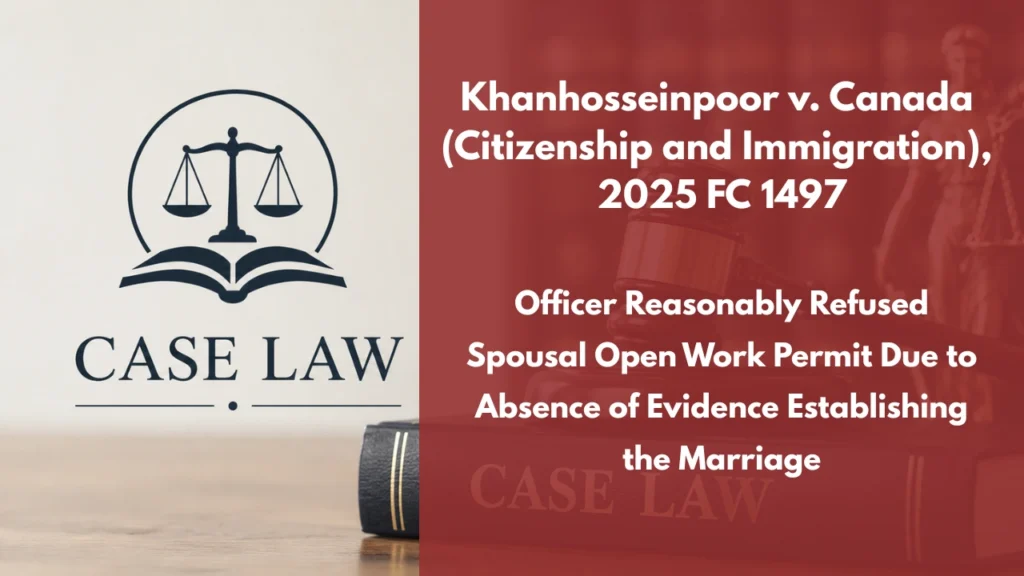
Khanhosseinpoor v. Canada (Citizenship and Immigration), 2025 FC 1497 (CanLII)
Prepared by:
Dr. Muhammad
Abrar (Barrister and
Solicitor)
Author | Writer | Mentor | Legal Researcher | Canadian
Immigration Case Law and Statistics Analyst