Ø Introduction
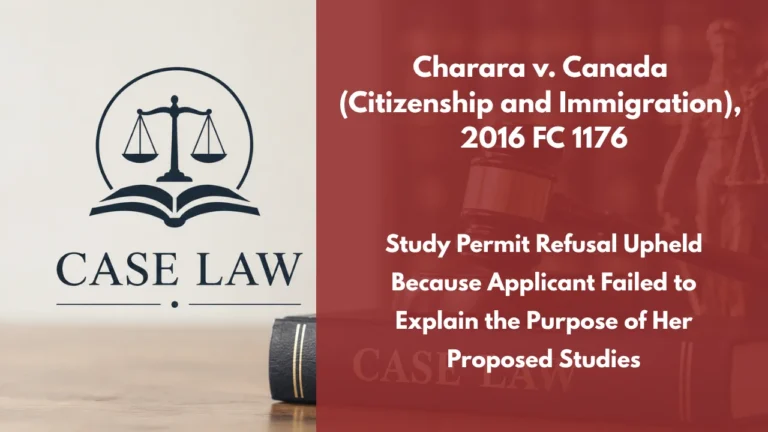
The Federal Court reviewed the refusal of a study permit
application by a Lebanese citizen and UAE permanent resident who had been
accepted into a vocational nursing program in Quebec.
Although the Court found that the officer erred in
assessing the applicant’s financial resources, it upheld the refusal
because the applicant had not adequately explained why her proposed studies
were consistent with her academic background and career plans.
Ø Key Principle
A study permit applicant bears the burden of demonstrating
that the proposed studies have a clear and credible purpose and that
they will leave Canada at the end of the authorized period.
A CAQ confirms that Quebec has accepted the applicant for
the purposes of provincial immigration requirements, but it does not replace
the federal officer’s assessment of study permit eligibility, including
financial capacity and temporary intent.
Ø Background
The applicant was 36 years old, married, and had a
three-year-old child. She held a Master of Science degree from the Université
Libanaise and had studied pharmacy and worked as an assistant pharmacist.
She was accepted into a vocational Health, Assistance and
Nursing Care program in Quebec and obtained a CAQ. Her husband provided
financial documentation showing employment income and savings.
The visa officer was not satisfied with her financial
resources, her intention to leave Canada, or the consistency of her proposed
studies with her academic background. The officer also questioned how she would
study full-time while being the sole caregiver for her young child.
Ø Court Findings
The Federal Court found that the officer incorrectly
assessed the applicant’s financial resources. Based on the evidence, the
family’s income and savings were objectively sufficient to cover the tuition
and living expenses, and the loan identified by the officer did not create the
financial problem the officer had assumed.
However, that error did not make the refusal unreasonable
because the officer had another valid and independent concern: the applicant
had failed to explain the purpose and logic of her proposed studies.
The applicant already held a master’s degree in science and
a diploma in pharmacy, yet proposed to undertake an undergraduate-level
vocational program in health. She did not provide a study plan explaining why
this additional program was necessary or how it connected to her professional
objectives.
The Court also confirmed that obtaining a CAQ does not
guarantee a study permit. Quebec and the federal government have separate
roles in the immigration process, and the federal officer remains responsible
for determining whether the requirements for a Canadian study permit are met.
The Court did, however, criticize the officer’s assumption
that the applicant could not adequately care for her child while studying
full-time, describing that reasoning as inappropriate. Nevertheless, the
remaining concerns about the unexplained study plan were sufficient to uphold
the refusal.
Ø Outcome
The Federal Court dismissed the application for judicial
review and upheld the study permit refusal.
Case Citation:
Charara v. Canada (Citizenship and Immigration), 2016 FC 1176 CanLII
Prepared by:
Dr. Muhammad
Abrar (Barrister and
Solicitor)
Author | Writer | Mentor | Legal Researcher | Canadian Immigration Case Law and
Statistics Analyst