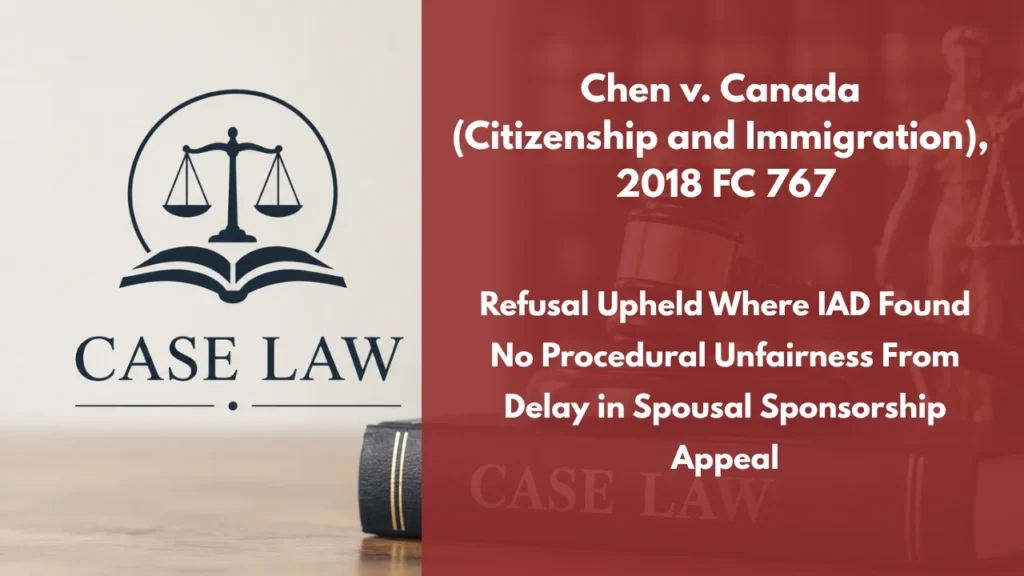
The Federal Court reviewed the
Immigration Appeal Division’s dismissal of Aijiao Chen’s spousal sponsorship
appeal. The IAD had upheld a visa officer’s finding that her marriage to
Xingsong Chen was not genuine and was entered into for immigration purposes. On
judicial review, Ms. Chen did not challenge that marriage finding. Instead, she
argued that administrative delay, restrictions on her testimony, and the IAD’s
treatment of her motions denied procedural fairness. The Court rejected those
arguments and dismissed the application.
Key Principle
Administrative delay in an
immigration proceeding does not, by itself, establish a breach of natural
justice or procedural fairness. An applicant must demonstrate meaningful
prejudice or other circumstances showing that the delay compromised the
fairness of the proceeding. The criminal-law framework in R v Jordan,
including its presumptive ceilings under section 11(b) of the Charter, does not
apply to immigration proceedings. A tribunal may also restrict irrelevant or
degrading testimony without breaching fairness.
Background
Ms. Chen, a Canadian permanent
resident and Chinese citizen, had used a wheelchair since childhood. She met
Mr. Chen in 2009 when he became her caregiver. They later developed a romantic
relationship, married in China in December 2013, and applied for spousal
sponsorship in 2014.
A visa officer refused the
application, finding the marriage non-genuine or primarily
immigration-motivated and also raising financial inadmissibility. Ms. Chen
appealed in February 2015. The IAD hearing was eventually held in July 2017
after postponements involving constitutional arguments and requests concerning
the interpreter used during the visa interview.
The IAD dismissed the appeal in
November 2017. Before the Federal Court, Ms. Chen focused on delay and
procedural fairness rather than challenging the IAD’s marriage findings.
Court Findings
• Administrative Delay Did Not
Establish Procedural Unfairness
Ms. Chen relied on Blencoe and argued that the IAD failed to properly assess the length, causes, and
prejudicial effects of the delay. The Court found she had not established
meaningful prejudice to her case. It also noted that the Blencoe framework had not been properly advanced before the IAD, making it
inappropriate to fault the tribunal for failing to apply it as argued on
judicial review.
• IAD Could Restrict
Irrelevant Testimony
Ms. Chen argued that she was
prevented from testifying about how her disability affected her use of the
toilet. The Court found no unfairness. Her significant mobility and
daily-living difficulties were undisputed, and the Minister had expressly
accepted those difficulties during the hearing. The proposed testimony would
therefore have added nothing relevant to the issues and could reasonably be
excluded as unnecessary and degrading.
• Jordan Does Not Govern
Immigration Delay
The Court disagreed with the
IAD’s suggestion that criminal delay is necessarily more serious than
immigration delay, but held that Jordan is confined to the criminal
context and section 11(b) of the Charter. There is no equivalent presumptive
processing ceiling for immigration appeals. Delay alone was insufficient, and
Ms. Chen had not demonstrated that the delay impaired the fairness of her IAD
proceeding.
Outcome
The Federal Court dismissed
judicial review. The IAD neither misapplied the law concerning administrative
delay nor denied Ms. Chen procedural fairness. No question of general
importance was certified.
Case
Citation:
Chen v. Canada (Citizenship and Immigration), 2018 FC 767 (CanLII)
Prepared by:
Dr. Muhammad
Abrar (Barrister and
Solicitor)
Author | Writer | Mentor | Legal Researcher | Canadian Immigration Case Law and
Statistics Analyst