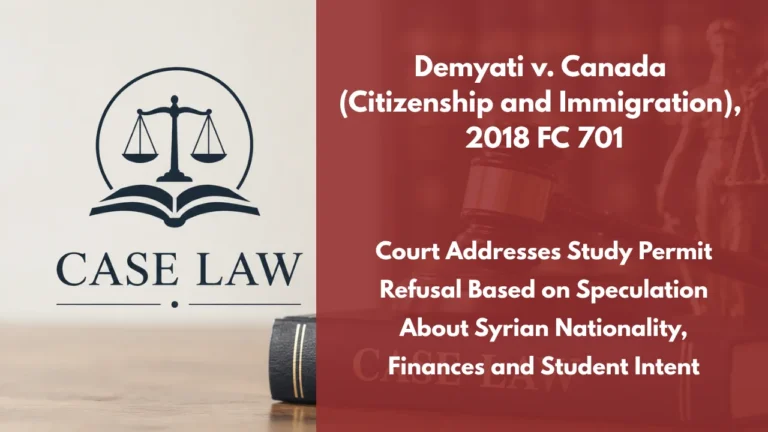
The Federal Court reviewed the
refusal of Ali Demyati’s study permit application to attend Carleton
University. The officer questioned whether he was a bona fide student, whether
he had sufficient funds, and whether he would leave Canada after his studies.
The Court found the reasons too unclear to permit meaningful review. The Court
found important conclusions unsupported or speculative, particularly those
concerning his Syrian nationality and UAE residence.
Key Principle
A visa officer is entitled to
significant deference and may rely on common sense when assessing a study
permit application, but cannot decide an application on intuition or a hunch.
Even brief reasons must contain enough justification, transparency and intelligibility
to reveal how the officer reached the conclusion. A reviewing court may connect
evidentiary “dots,” but cannot invent missing reasons or fill critical gaps
through speculation.
Background
Mr. Demyati was a 19-year-old
Syrian citizen who had spent most of his life in the UAE with his parents,
grandparents and siblings. He had previously studied in Thailand and Hungary
and had returned to his country of residence after studying abroad.
Carleton University accepted him
into its Bachelor of Science Honours program and awarded him a $4,000 annual
scholarship plus a $1,000 entrance award. After an initial refusal, he
reapplied with his academic record, detailed study plan, family financial-support
letters and evidence of their ability to support him.
The second application was
refused. The officer cited his temporary UAE status, employment prospects,
current employment, finances, source of funds, past education and concerns that
he would not actively pursue his studies or leave Canada.
Court Findings
• Bona Fide Student Finding
Was Not Explained
The Court could not determine why
an 18-year-old student admitted to a recognized university with scholarship
funding would not genuinely pursue his studies. Nothing in the reasons
explained why Mr. Demyati was likely to breach the requirement to remain enrolled
and actively pursue his program. If a justification existed, the officer had to
articulate it.
• Financial Analysis
Misunderstood the Evidence
The officer emphasized that Mr.
Demyati had no personal income or significant savings. The Court found this
reasoning difficult to understand for a young student whose studies had been
uninterrupted. His uncle had pledged substantial annual support, his grandfather
also promised assistance, and he had scholarship funding. More importantly, the
officer appeared to mistake the grandfather’s bank statements for Mr. Demyati’s
own financial records.
• Syrian Nationality Concern
Appeared Speculative
The Court considered Mr.
Demyati’s Syrian nationality and long residence outside Syria to have
apparently been an important factor. The officer seemed to infer that Syria’s
armed conflict and instability, combined with potentially temporary UAE status,
increased the possibility that he would remain in Canada. On the record,
however, the Court characterized this reasoning as closer to a hunch than an
evidence-based justification. The reasons did not adequately explain how these
circumstances established an intention to remain in Canada.
Outcome
The Federal Court granted
judicial review and remitted the study permit application to a different visa
officer for a new determination. The Court declined costs because no special
reasons existed and certified no question of general importance.
Case
Citation:
Demyati v. Canada (Citizenship and Immigration), 2018 FC 701 (CanLII)
Prepared by:
Dr. Muhammad
Abrar (Barrister and
Solicitor)
Author | Writer | Mentor | Legal Researcher | Canadian Immigration Case Law and
Statistics Analyst