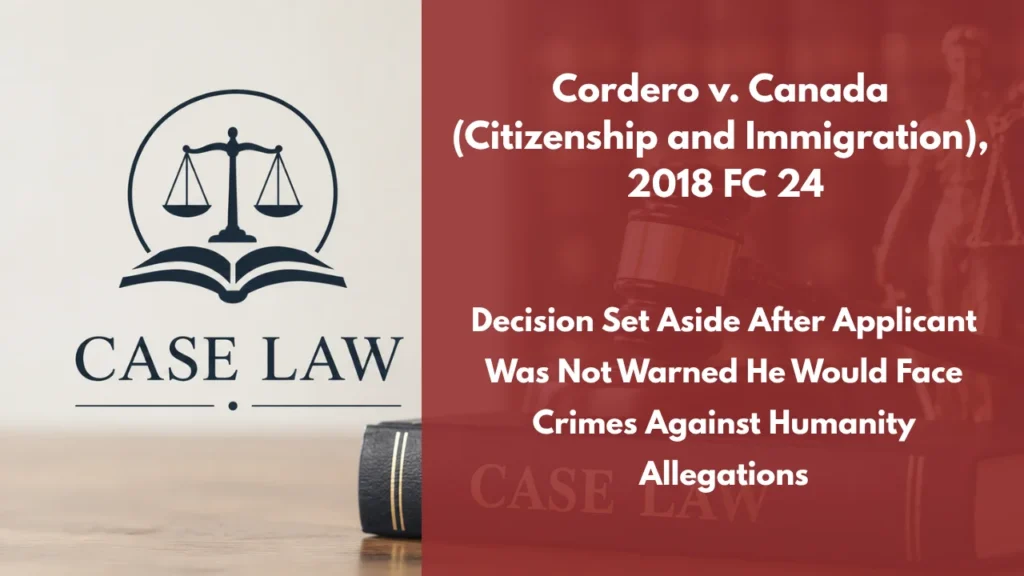
The Federal Court reviewed the
refusal of Rey Cordero’s spousal permanent residence application. Mr. Cordero,
a former member of the Armed Forces of the Philippines, was found inadmissible
under paragraph 35(1)(a) of the IRPA after the officer found reasonable grounds
to believe he was complicit in crimes against humanity committed by his
infantry battalion. The Court granted judicial review because Mr. Cordero
received no advance notice that complicity in crimes against humanity would be
addressed at his interview or a meaningful opportunity to respond.
Key Principle
Even where the duty of procedural
fairness owed to an overseas permanent residence applicant is relatively
minimal, the applicant must know the case to meet and receive a meaningful
opportunity to answer it. Where allegations involve complicity in crimes
against humanity, their seriousness may require advance notice. Confronting an
applicant with allegations during an interview may be insufficient when that
interview is the applicant’s only opportunity to respond.
Background
Mr. Cordero, a citizen of the
Philippines, served in the Armed Forces of the Philippines from 2006 to 2011,
including with the 11th Infantry Battalion. The Battalion was known to have
committed crimes against humanity where he had served.
After marrying Canadian permanent
resident Christiene June Labestre in 2014, Mr. Cordero applied for permanent
residence through spousal sponsorship. During processing, he was asked to
complete a chart detailing his military service. Two years later, he was
interviewed.
At the interview, the officer
questioned him extensively about the Battalion and reports concerning human
rights abuses. The officer found reasonable grounds to believe Mr. Cordero had
been complicit in crimes against humanity and refused the application under
paragraph 35(1)(a) of the IRPA.
Court Findings
• Military Information Request
Did Not Provide Adequate Notice
The Court rejected the argument
that being asked to provide routine military details should have alerted Mr.
Cordero that he was suspected of complicity in crimes against humanity.
Information about rank, unit, duties, commanders, and locations was different
from notice that he had to defend himself against such an allegation.
• Raising Allegations at the
Interview Was Insufficient
The officer disclosed the
concerns only during the interview and asked Mr. Cordero to respond immediately
to reports concerning the Battalion. Given the gravity and legal complexity of
complicity under Ezokola, this did not provide a meaningful opportunity
to prepare or obtain evidence answering the allegations.
• Existing CBSA Report
Strengthened the Fairness Concern
More than a year before the
interview, CBSA had prepared an inadmissibility assessment applying the six Ezokola factors and concluding there were reasonable grounds to believe Mr. Cordero was
complicit. Although he was not necessarily entitled to the report itself, its
substantive concerns could have been communicated beforehand. The absence of
advance disclosure deprived him of an opportunity to present responsive
evidence.
Outcome
The Federal Court granted
judicial review on procedural fairness grounds and did not decide the remaining
arguments concerning the War Crimes Act or reasonableness of the complicity
finding. The refusal was set aside and the matter remitted to a different visa
officer for redetermination. No question was certified.
Case
Citation:
Cordero v. Canada (Citizenship and Immigration), 2018 FC 24 (CanLII)
Prepared by:
Dr. Muhammad
Abrar (Barrister and
Solicitor)
Author | Writer | Mentor | Legal Researcher | Canadian Immigration Case Law and
Statistics Analyst