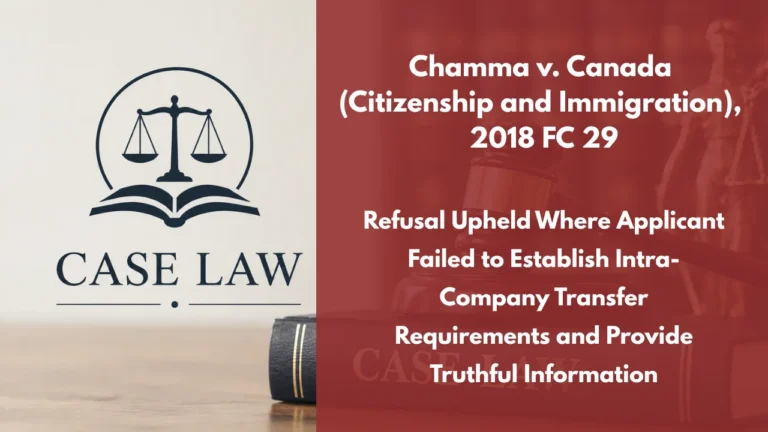
The Federal Court reviewed the
refusal of Shahzad Chamma’s intra-company transfer work permit application. Mr.
Chamma sought to establish a Canadian affiliate of his Pakistani electronics
business and work in Canada as a senior manager without an LMIA. The officer
was not satisfied that he met the requirements for an LMIA-exempt intra-company
transfer, questioned the evidence connecting him to the Pakistani business,
identified credibility concerns, and found that he had failed to answer
immigration questions truthfully. The Court concluded that the refusal was
reasonable.
Key Principle
An applicant seeking an
LMIA-exempt intra-company transfer bears the burden of providing sufficient
credible evidence establishing the applicable requirements, including
qualifying employment with the foreign enterprise. An officer may refuse where
the evidence is inadequate and may independently refuse under subsection 11(1)
of the IRPA where the applicant breaches the section 16 duty of candour by
providing inaccurate or incomplete information.
Background
Mr. Chamma, a Pakistani citizen,
had operated Chamma Electronics Inc. in Pakistan since 1997. A Canadian company
was incorporated in November 2016, with Mr. Chamma owning 75 percent of its
shares. He proposed investing $100,000 and transferring to Canada for one year
as a senior manager to launch the Canadian affiliate.
He applied for an intra-company
transfer work permit in January 2017. The officer concluded that the evidence
did not adequately establish his senior managerial employment with the
Pakistani business or satisfy the applicable intra-company transfer requirements.
The officer also identified
credibility concerns. Mr. Chamma failed to disclose a 2002 Canadian TRV
refusal, stated that his spouse and children would not accompany him although
they were already in Canada, and provided information creating a discrepancy
concerning when his father died and when the Pakistani business was transferred
to him.
Court Findings
• Applicant Failed to
Establish Intra-Company Transfer Eligibility
The Court upheld the officer’s
concern that Mr. Chamma had not provided clear and compelling evidence
establishing that he was actually employed by and managing the Pakistani
business. The applicant bears responsibility for putting forward his best case and
supplying sufficient supporting documentation. The officer was entitled to
assess whether the requirements for the LMIA-exempt intra-company transfer
category were established.
• Credibility Concerns Were
Reasonably Considered
The officer reasonably considered
inconsistencies concerning Mr. Chamma’s father and the transfer of the
business. The discrepancy between his statement that his family would not
accompany him and the fact that his spouse and children were already in Canada
also supported concerns about the reliability of the information provided.
• Breach of Duty of Candour
Independently Supported Refusal
The Court emphasized subsection
16(1) of the IRPA, which requires applicants to answer immigration questions
truthfully. Mr. Chamma answered “no” when asked whether he had previously been
refused a visa despite his 2002 Canadian TRV refusal. He also failed to
accurately describe his family’s circumstances in Canada. The Court held that
his failure to comply with the duty of candour was sufficient, by itself, to
support refusal under subsection 11(1).
Outcome
The Federal Court dismissed the
application for judicial review, finding the officer’s decision fell within the
range of acceptable outcomes supported by the facts and law. No serious
question of general importance was certified.
Case
Citation:
Chamma v. Canada (Citizenship and Immigration), 2018 FC 29 (CanLII)
Prepared by:
Dr. Muhammad
Abrar (Barrister and
Solicitor)
Author | Writer | Mentor | Legal Researcher | Canadian Immigration Case Law and
Statistics Analyst