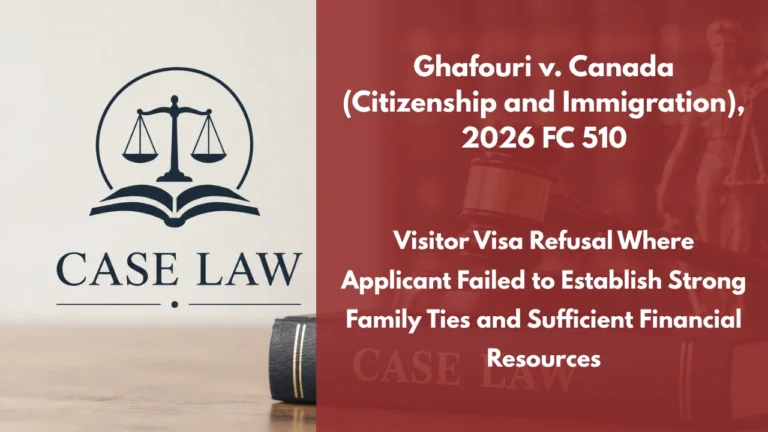
In Ghafouri v. Canada
(Citizenship and Immigration), 2026 FC 510, the Federal Court reviewed the
refusal of Temporary Resident Visa (TRV) applications for the Applicant, his
wife, and daughter, who intended to visit Canada for one month. The visa
officer was not satisfied that they would leave Canada at the end of their
authorized stay. The Applicant argued that the decision was unreasonable and
procedurally unfair. The Court dismissed the application, finding that the
officer reasonably assessed the evidence concerning family ties, financial
resources, and travel history.
Key Principles
A temporary resident visa
applicant bears the burden of satisfying the officer that they will leave
Canada at the end of the authorized period. Officers are entitled to assess the
applicant’s family ties, financial circumstances, and travel history and determine
the weight to be given to the evidence. On judicial review, the Court will not
reweigh evidence where the officer’s findings are reasonably supported by the
record.
Bank transaction histories can
assist in demonstrating the source and stability of funds. Where
substantial funds are held in accounts without transaction histories, an
officer may reasonably give that evidence reduced weight. There is also no
general requirement for a visa officer to provide an applicant with an
opportunity to respond to deficiencies identified in the application.
Background
The Applicant, a citizen of Iran,
applied for visitor visas for himself, his wife, and daughter to visit Canada
for one month. The officer found that the family had insufficient family ties
outside Canada because they would all be travelling together.
The Applicant relied on an
affidavit from his mother in Iran, who stated that she had health problems and
depended on him as her primary caregiver. He also provided bank statements
showing more than $47,000 CAD and relied on his travel history to
demonstrate his intention to return to Iran.
Court Findings
➢ Family Ties
The Court found that the officer
reasonably considered the Applicant’s mother’s affidavit. Although the
affidavit established that she required daily assistance, it did not explain
who would care for her during the Applicant’s one-month absence. The Applicant
did not identify any overlooked evidence. Therefore, it was reasonable for the
officer to give the evidence reduced weight.
➢ Financial Evidence
The Court upheld the officer’s
assessment of the Applicant’s financial resources. Although the Applicant had
more than $47,000 CAD in his bank accounts, the majority of the funds were held
in accounts without transaction histories. The Court confirmed that transaction
histories can demonstrate the source and stability of funds, and their absence
may reasonably support concerns about whether the funds are sufficiently
established and available.
➢ Travel History
The Applicant had made only two
trips outside Iran since 2015. The officer found this insufficient to
constitute a strong positive factor. The Court held that this finding was open
to the officer, particularly because the Applicant failed to identify any
relevant travel evidence that had been overlooked.
➢ Procedural Fairness
The Court rejected the procedural
fairness argument. A visa officer is not generally required to provide an
applicant with an opportunity to respond to deficiencies in the application
before making a decision.
Outcome
The Federal Court dismissed
the judicial review, finding that the Applicant failed to establish any
reviewable error in the officer’s assessment of family ties, financial
resources, or travel history. No question was certified.
Case
Citation:
Ghafouri v. Canada (Citizenship and Immigration), 2026 FC 510 (CanLII)
Prepared by:
Dr. Muhammad
Abrar (Barrister and
Solicitor)
Author | Writer | Mentor | Legal Researcher | Canadian Immigration Case Law and
Statistics Analyst