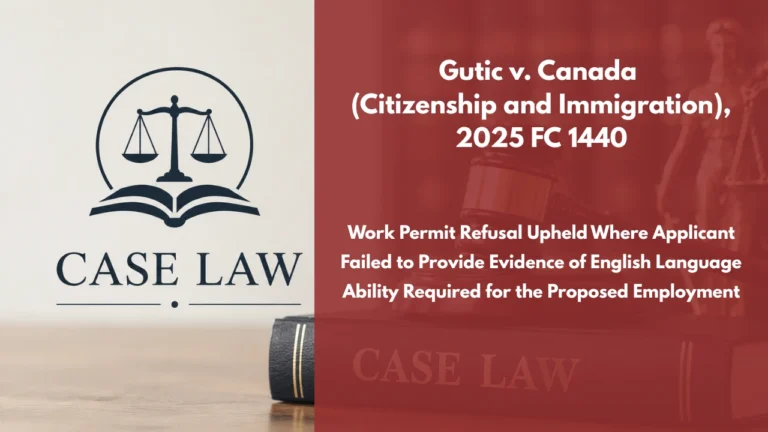
The Federal Court reviewed IRCC’s
refusal of Mirsad Gutic’s work permit application for employment as a concrete
finisher. The officer refused the application because the applicant had not
demonstrated that he could meet the English language requirements of the
proposed job. The Court dismissed the judicial review, finding that the officer
reasonably concluded that the applicant failed to provide sufficient evidence
of his language ability.
Key Principle
The Federal Court reaffirmed that
applicants bear the burden of proving they meet the requirements for a work
permit and the proposed employment. Officers are not required to accept
unsupported statements or rely solely on an applicant’s assertions. While
officers must provide reasonable explanations, courts will not intervene where
the decision is based on the evidence before the officer.
Background
The applicant, a foreign
national, applied for a work permit to work as a concrete finisher. The
prospective employer required oral and written English skills for the position.
The officer refused the
application under paragraph 200(3)(a) of the Immigration and Refugee
Protection Regulations, finding that the applicant had not demonstrated
sufficient English language ability. The Global Case Management System notes
stated that the applicant had failed to provide official language test results,
such as IELTS, as proof of English proficiency.
The applicant argued that there
was no requirement to provide an official language test and that he had
demonstrated his ability through his interactions with the employer and
workplace team. He relied on a previous case where employer evidence regarding
language ability had been considered relevant.
Court Findings
• Applicant Failed to Prove
Language Ability
The Court found that the
applicant did not provide evidence demonstrating his English proficiency.
Statements from counsel that the applicant had met the employer, understood the
work, and communicated well with the team were not evidence of actual language
ability.
Justice Pallotta held that it was
the applicant’s responsibility to provide evidence showing that he could
perform the proposed employment.
• Official Language Test Was
Not Mandatory
The Court clarified that the
officer was not requiring a specific language test. Although the officer
referenced IELTS as an example, the refusal was based on the absence of
evidence demonstrating English ability, not the absence of a particular test
result.
• Previous Case Was
Distinguishable
The Court found that the
applicant’s reliance on Choi v Canada was misplaced because, unlike that
case, the employer here had not provided a letter confirming confidence in the
applicant’s language skills. In any event, officers are not bound by an
employer’s assessment of an applicant’s abilities.
Outcome
The Federal Court dismissed the
application for judicial review. The Court found that the officer reasonably
refused the work permit application under paragraph 200(3)(a) of the
Regulations. No question was certified.
Case Citation:
Gutic v. Canada (Citizenship and Immigration),
2025 FC 1440 (CanLII)
Prepared by:
Dr. Muhammad Abrar (Barrister and Solicitor)
Author | Writer | Mentor | Legal Researcher | Canadian Immigration Case Law and Statistics Analyst