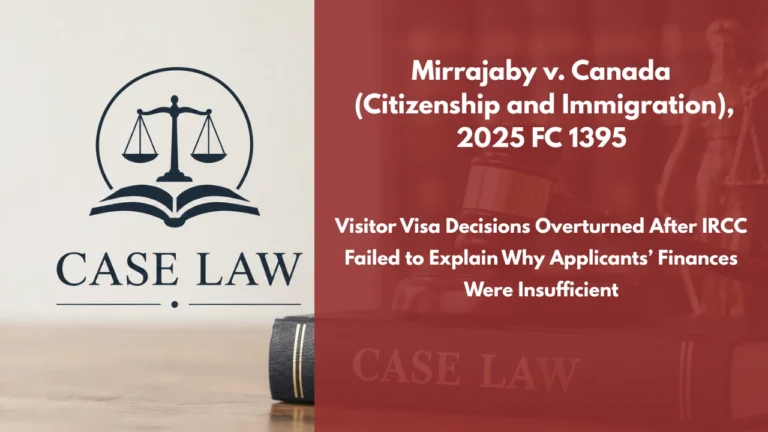
The Federal Court reviewed IRCC’s refusal of temporary
resident visa (TRV) applications submitted by Ziba Mirrajaby and her son,
Amirali Sharifi Rasteh Kenari. The applicants intended to visit Ms. Mirrajaby’s
husband in Canada for two weeks. The officer refused the applications, finding
that the applicants lacked sufficient financial resources and that their visit
was inconsistent with a temporary stay. The Court granted judicial review,
finding that the officer relied on boilerplate reasoning and failed to explain
why the applicants’ financial evidence was insufficient.
Key Principle
The Federal Court reaffirmed that visa officers may use
brief or standardized reasons, but those reasons must still provide a
transparent, intelligible, and justified explanation based on the applicant’s
specific circumstances. Boilerplate statements are insufficient when they fail
to engage with important evidence supporting the application.
Background
The applicants, citizens of Iran, applied for TRVs in July
2024 to visit Ms. Mirrajaby’s husband, who was working in Canada on an open
work permit. The planned visit was for two weeks in August 2024.
The applicants submitted financial information and
supporting documents demonstrating their ability to support the visit. However,
IRCC refused both applications on July 31, 2024.
The officer’s GCMS notes stated that:
- The
applicants’ assets and financial situation were insufficient to support
the purpose of travel.
- The
purpose of the visit was not consistent with a temporary stay.
- The
husband in Canada was not sufficiently established to support family
members because he obtained his open work permit under a temporary public
policy.
Court Findings
• Financial Assessment Lacked Explanation
The Court found that the officer failed to explain why the
applicants’ financial evidence was insufficient. The reasons only repeated that
their assets were inadequate without analyzing the specific financial
information submitted.
Justice Norris held that given the detailed financial
documents provided and the short two-week visit planned, the officer was
required to provide some explanation showing how the conclusion was reached.
• Boilerplate Reasons Were Insufficient
The Court noted that template language is not automatically
unreasonable. However, reasons must still demonstrate engagement with the
applicant’s individual circumstances.
In this case, the officer’s reasons did not explain why the
applicants’ financial situation, travel purpose, or host’s circumstances
justified refusal.
• Procedural Fairness Issue Not Addressed
Because the Court found the decisions unreasonable, it was
unnecessary to consider the applicants’ separate procedural fairness arguments.
Outcome
The Federal Court granted the application for judicial
review and set aside the July 31, 2024 TRV refusals. The Court did not order
reconsideration of the original applications because the planned travel dates
had passed. If the applicants submit new TRV applications, they must be
considered by a different decision-maker. No question was certified.
Case Citation:
Mirrajaby v.
Canada (Citizenship and Immigration), 2025 FC 1395 (CanLII)
Prepared by:
Dr. Muhammad Abrar (Barrister and Solicitor)
Author | Writer | Mentor | Legal Researcher | Canadian Immigration Case Law and Statistics Analyst