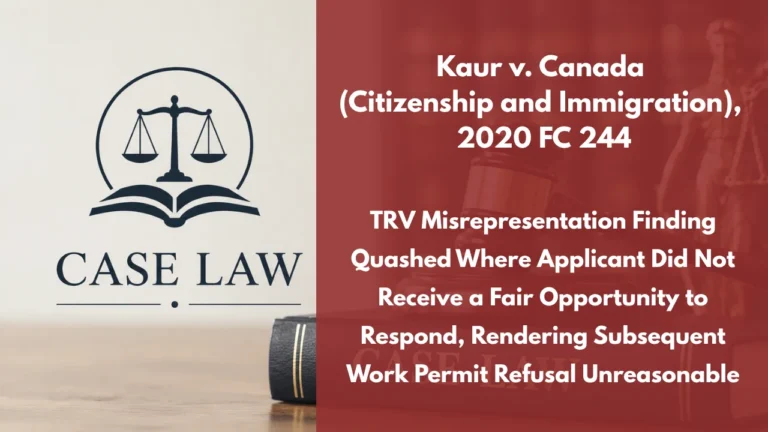
The Federal Court reviewed two
related decisions concerning Jasmeen Kaur. The first refused a Temporary
Resident Visa based on misrepresentation under subsection 40(1) of the IRPA.
The second refused her work permit application because she remained inadmissible
as a result of that earlier misrepresentation finding.
Ms. Kaur maintained that she had
never authorized the TRV application, did not know it had been filed, and never
received the procedural fairness letter concerning alleged fraudulent
information. The Court found that procedural fairness had not been satisfied in
the TRV decision. Because the work permit refusal depended entirely on that
misrepresentation finding, it could not stand either.
Key Principle
Where a finding of
misrepresentation under section 40 of the IRPA is based on alleged fraudulent
information, procedural fairness requires that the applicant receive a
meaningful opportunity to know and answer the case against them. If the
evidence does not establish that the procedural fairness letter was actually
delivered or otherwise brought to the applicant’s attention, a serious
misrepresentation finding may be procedurally unfair. A later immigration
refusal that depends entirely on that defective finding is likewise
unreasonable and cannot stand.
Background
Ms. Kaur, a citizen of India,
visited an immigration consultant’s office in December 2017 to discuss a
possible Canadian visitor visa. She said she did not sign a retainer, did not
pay a fee, and never authorized the consultant to file an application. She did,
however, leave supporting documents including her passport copy, employment
letter, resume, salary information, and tax return.
A TRV application in her name was
received by the Canadian High Commission in New Delhi shortly afterward. Ms.
Kaur said she did not know the application had been submitted.
IRCC later issued a procedural
fairness letter alleging fraudulent information in the application. Ms. Kaur
swore that she never received that letter.
The TRV was then refused for
misrepresentation. In 2019, Ms. Kaur applied for a work permit as a British
Columbia provincial nominee. That application was refused because the earlier
misrepresentation finding made her inadmissible.
Court Findings
• Applicant Was Not Shown to
Have Received the Procedural Fairness Letter
The Court focused on whether Ms.
Kaur had actually been given an opportunity to answer the officer’s concerns.
The Respondent filed no affidavit
explaining how the procedural fairness letter had been sent or establishing
that it had reached Ms. Kaur. There was therefore no evidence contradicting her
sworn evidence that she had not received it.
The Court concluded that she had
not been given a meaningful opportunity to respond before the misrepresentation
finding was made.
• Serious Misrepresentation
Finding Could Not Stand
The record also contained
evidence suggesting that documents in the TRV application were false or
inconsistent with Ms. Kaur’s actual information. She alleged that signatures
were forged and that basic personal, employment, family, and financial information
was incorrect.
A solemn declaration submitted
with the TRV application also purported to bear the name of an Ontario lawyer,
who swore that he had neither prepared nor signed it.
Against that factual background,
the absence of a fair opportunity to respond was especially significant.
• Work Permit Refusal Fell
With the TRV Decision
The work permit refusal rested
entirely on the earlier finding that Ms. Kaur was inadmissible for
misrepresentation.
Once the misrepresentation
decision was found procedurally unfair, the factual foundation of the work
permit refusal disappeared. The Court therefore found that the work permit
decision was based on an unreasonable factual premise and could not stand.
• Certified Question Was
Declined
Ms. Kaur proposed a broader
question about whether a foreign national can be inadmissible for
misrepresentation where an unauthorized third party files an application
without the foreign national’s knowledge.
The Court declined to certify the
question because the case was resolved on its particular facts and procedural
fairness concerns rather than on that broader legal issue.
Outcome
The Federal Court allowed both
judicial review applications. The TRV misrepresentation decision was quashed,
and the work permit refusal was set aside and remitted to a different officer
for redetermination. No question of general importance was certified.
Case
Citation:
Kaur v. Canada (Citizenship and Immigration), 2020 FC 244 (CanLII)
Prepared by:
Dr. Muhammad
Abrar (Barrister and
Solicitor)
Author | Writer | Mentor | Legal Researcher | Canadian
Immigration Case Law and Statistics Analyst