The Federal
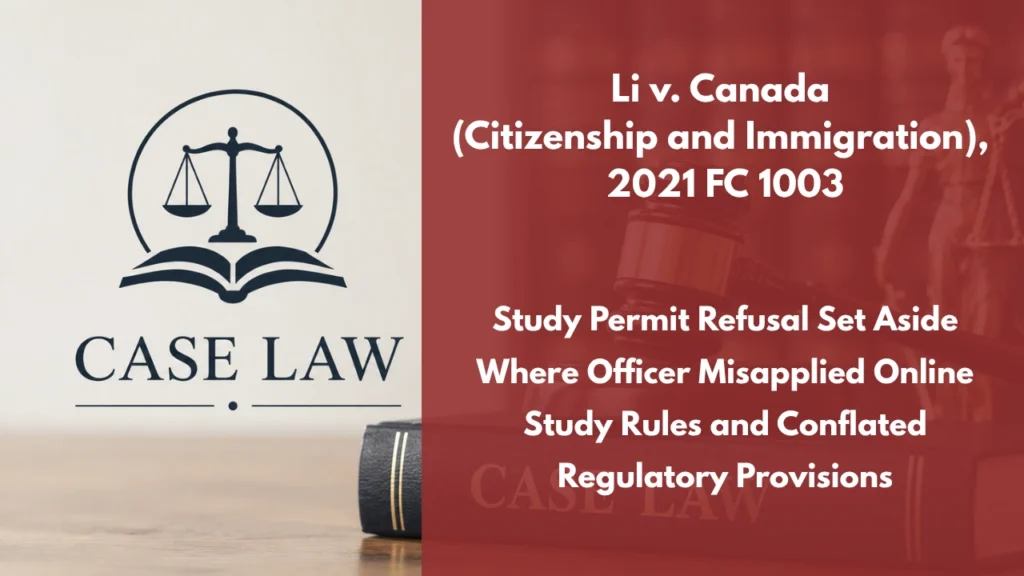
Court reviewed Gao Li’s refusal of an inland study permit application. The
officer found that he was not eligible to apply from within Canada because he
completed a prerequisite English course after the expiry of his visitor status
period. The Court found the decision unreasonable because the officer
incorrectly imported requirements from one regulatory provision into another
and failed to analyze the applicant’s online course circumstances.
Key
Principle
A decision-maker must apply the correct statutory and regulatory
framework. Provisions that appear related cannot be combined without legal
justification. Where an applicant relies on a specific eligibility pathway, the
officer must analyze that pathway directly and consider relevant circumstances,
including applicable policy guidance and the nature of the studies completed.
Background
The
applicant was a Chinese citizen who entered Canada as a visitor in January
2020. His visitor status was extended until November 2020. While in Canada, he
completed an online English prerequisite course from June 1, 2020, to November
6, 2020, and applied for a study permit for a Culinary Management Program at
Centennial College under subparagraph 215(1)(f)(iii) of the IRPR.
The officer
refused the application, stating that the prerequisite course was completed
after the initial six-month period authorized upon entry and that the applicant
therefore could not apply for a study permit from within Canada.
Court
Findings
• Officer’s
Affidavit Could Not Repair the Decision
The Court
refused to rely on the officer’s later affidavit because it attempted to expand
upon the limited reasons in the decision. The affidavit introduced detailed
discussion of Program Delivery Instructions that were not referenced as the
basis for the refusal. The Court held that an officer cannot supplement
deficient reasons after the fact through affidavit evidence.
•
Applicant’s Functus Officio Argument Failed
The
applicant argued that the officer initially found him eligible and could not
later reverse the decision. The Court rejected this argument because the
initial assessment was never communicated to the applicant and no formal
decision had been issued. The doctrine of functus officio therefore did not
apply.
• Officer
Conflated Different Regulatory Provisions
The
applicant applied under subparagraph 215(1)(f)(iii), which allows certain
temporary residents to apply for study permits from within Canada after
completing a prerequisite course. The officer instead relied on paragraph
188(1)(c), which concerns individuals who do not require a study permit for
short courses completed within their authorized stay.
The Court
found that the officer imported the six-month limitation from paragraph
188(1)(c) into the analysis of subparagraph 215(1)(f)(iii), even though the
latter provision does not incorporate that requirement. The legislation did not
support that interpretation.
• Online
Study Circumstances Were Not Considered
The
applicant argued that his English prerequisite course was completed online and
therefore was not subject to the same study permit requirements as an in-person
program. The Court found that the officer failed to address this argument or
consider whether the COVID-era Program Delivery Instructions applied to his
circumstances.
• Decision
Lacked Rational Chain of Analysis
The Court
held that the officer failed to engage with the actual provision relied upon by
the applicant and did not explain why the online prerequisite course prevented
him from applying inside Canada. The decision therefore lacked the internally
coherent reasoning required by Vavilov.
• Certified
Questions Were Not Appropriate
The
applicant proposed questions concerning unauthorized study and distance
learning. The Court declined certification because the case depended heavily on
its specific facts rather than a broad legal issue requiring appellate
guidance.
Outcome
The Federal
Court granted judicial review, set aside the refusal, and remitted the study
permit application to a different officer for redetermination. No question of
general importance was certified.
Case
Citation:
Li v. Canada (Citizenship and Immigration), 2021 FC 1003 (CanLII)
Prepared by:
Dr. Muhammad Abrar (Barrister and Solicitor)
Author | Writer | Mentor | Legal Researcher | Canadian Immigration Case Law and Statistics Analyst