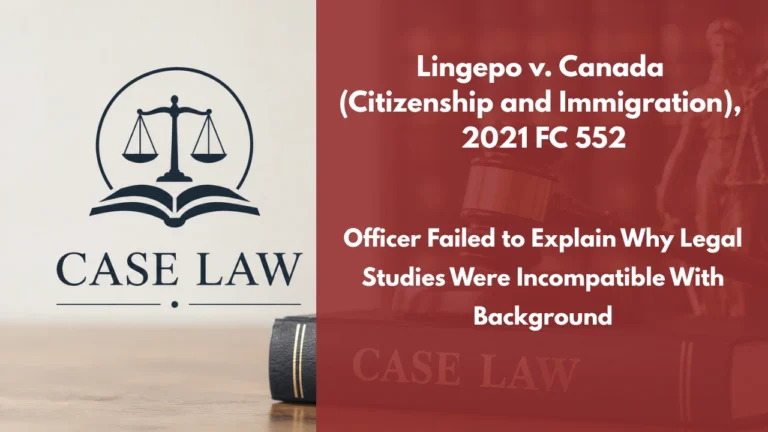
The Federal Court reviewed Michel
Molonga Lingepo’s refusal of a study permit. The officer questioned his
proposed studies, finances, and likelihood of leaving Canada. The Court found
the decision unreasonable because the reasons did not explain how the evidence
supported the refusal.
Key Principle
A study permit refusal must
contain an intelligible and rational chain of reasoning. Although visa officers
are not required to provide lengthy reasons, they must address central evidence
and explain conclusions that are not apparent from the record. Generic
statements and unexplained negative inferences cannot substitute for responsive
reasoning.
Background
The applicant, a Congolese
lawyer, had been a member of the Kinshasa Bar since 2003 and held a 55%
interest in a law firm. He sought Canadian studies to deepen his understanding
of bijural law and reported more than US$67,440 in his bank account.
Court Findings
• Officer Failed to Explain
Why the Study Plan Was Questionable
The officer found the study plan
questionable because of the applicant’s previous studies and background. The
Court found no explanation for why his legal education and professional
experience were incompatible with further legal studies in Canada. His evidence
showed that the studies could benefit his legal career in the DRC.
• Cost of Studies Was Not
Properly Connected to the Evidence
The officer considered the
program’s cost disproportionate in light of the applicant’s financial
situation, family resources, and employment prospects. The Court found this
inadequately justified. The applicant was a majority partner in a law firm and
had substantial funds available, making the officer’s reference to his
potential salary and financial capacity unclear.
• Officer Could Not Determine
the Value of Further Education
The Court emphasized that it is
not the officer’s role to determine the value of learning to an applicant.
• Financial Evidence Was Not
Properly Assessed
The applicant’s bank statements
showed more than US$67,440 in cash, while annual tuition was approximately
$21,063. The Court found that, on its face, he appeared capable of covering the
first year of study and living expenses. The Respondent suggested that deposits
and withdrawals raised questions about account ownership, but there was no
indication that the officer had actually relied on that concern.
• Family Support Obligations
Were Misapplied
The Respondent also suggested
that the applicant’s resources had to account for his wife and five children.
The Court rejected this because he was travelling alone. The regulation
concerned the applicant and accompanying family members.
• Reasons Failed to Establish
a Rational Connection
The Court acknowledged that study
permit decisions receive considerable deference and that reasons need not be
extensive. Nevertheless, it could not understand how the officer reached the
conclusions from the reasons provided. The decision therefore lacked
justification, transparency, and intelligibility.
• The Court Did Not Substitute
Its Own Assessment
The Court held only that the
refusal required adequate explanation and reconsideration.
Outcome
The Federal Court allowed
judicial review, set aside the November 20, 2019 decision, and remitted the
matter to a different officer for redetermination. No question of general
importance was certified.
Case
Citation:
Lingepo v. Canada (Citizenship and Immigration), 2021 FC 552 (CanLII)
Prepared by:
Dr. Muhammad Abrar (Barrister and Solicitor)
Author | Writer | Mentor | Legal Researcher | Canadian Immigration Case Law and Statistics Analyst