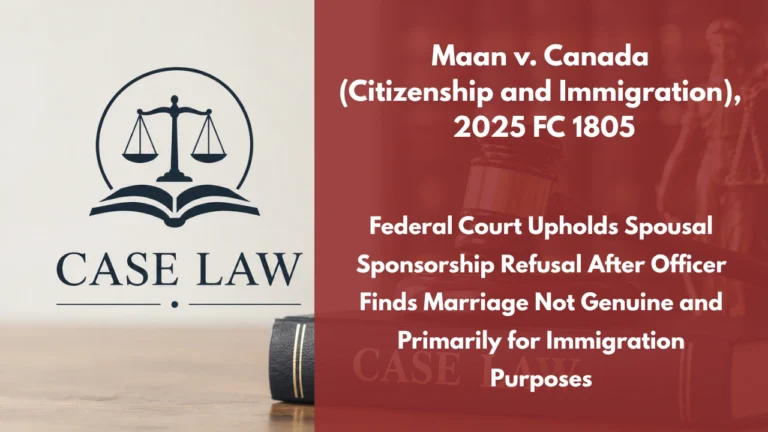
The Federal Court dismissed an application for judicial
review of the refusal of an inland spousal sponsorship application. The
immigration officer concluded that the Applicant’s marriage had been entered
into primarily for the purpose of acquiring immigration status under subsection
4(1) of the Immigration and Refugee Protection Regulations (IRPR). The
Court found that the officer’s assessment was reasonable and that the Applicant
had failed to establish any procedural unfairness.
Key Principle
Under subsection 4(1) of the IRPR, a foreign national is not
considered a spouse if the marriage was entered into primarily to acquire
immigration status or if the relationship is not genuine. On judicial review,
the Court must not reweigh evidence concerning relationship genuineness. Where
the evidentiary record is mixed, an officer may reasonably reach a conclusion
within the range of acceptable outcomes, provided the decision is supported by
a rational analysis.
Background
The Applicant, an Indian citizen, came to Canada in December
2016 on a study permit. He enrolled in an Electrical Engineering Technician
program but withdrew after approximately eight months and did not subsequently
resume his studies in a sustained manner. In December 2019, he met his spouse,
Ramneek Kaur Padda, and they began a relationship. They married in April 2020
and their marriage was officially registered in October 2020. The Applicant
applied for permanent residence under the Spouse or Common-Law Partner in
Canada Class in October 2021.
During the assessment, IRCC requested additional evidence
regarding the genuineness of the marriage. In June 2024, an officer contacted
the Applicant and was told that he and his spouse lived together in Brampton.
The officer subsequently contacted the landlord and another resident of the
property. Their statements raised concerns about whether the Applicant and his
spouse actually lived together. The couple was then interviewed, and the
officer identified several discrepancies in their evidence. The application was
refused on the basis that the marriage had been entered into primarily for
immigration purposes.
Court Findings
• Mixed Evidence Supported the Officer’s Conclusion
Although the Applicant provided a marriage certificate,
photographs, financial documents, affidavits, and proof of cohabitation, there
was contradictory evidence concerning the couple’s residence. The landlord
stated that he was unaware of any women living at the residence, while another
roommate indicated that the Applicant had moved out approximately a year
earlier. These concerns reasonably prompted the officer to conduct an
interview.
• The Court Would Not Reweigh the Evidence
The Court acknowledged that many interview inconsistencies
were relatively minor and that it might have reached a different conclusion.
However, determining whether a marriage is genuine is not the Court’s role on
judicial review. The Applicant bore the burden of establishing that the
statutory requirements were met, and the officer’s conclusion was within the
range of reasonable outcomes.
• Procedural Fairness Was Satisfied
The Court rejected allegations that the officer was biased
because of the Applicant’s criminal proceedings. The criminal history was
addressed only after extensive questioning concerning the relationship, and
there was no evidence that it played a disproportionate role. The couple was
also informed of the concerns and given opportunities to respond during the
interview.
Outcome
The Federal Court dismissed the application for judicial
review. No question was certified. The Court also ordered the Applicant’s
counsel to personally pay $750 in costs because of counsel’s failure to
appear at the scheduled hearing and failure to adequately communicate with the
Court.
Case Citation:
Maan v. Canada (Citizenship and Immigration), 2025 FC 1805 (CanLII)
Prepared by:
Dr. Muhammad
Abrar (Barrister and
Solicitor)
Author | Writer | Mentor | Legal Researcher | Canadian
Immigration Case Law and Statistics Analyst