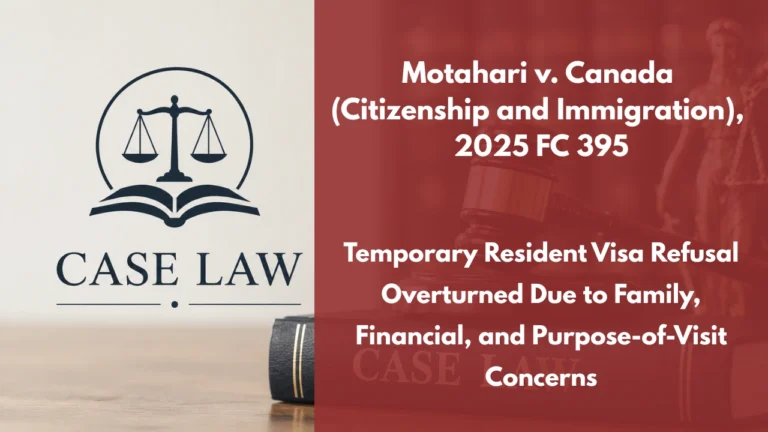
The Federal Court reviewed IRCC’s
refusal of Nayereh Motahari’s temporary resident visa application. The
applicant, a dual citizen of Iran and Dominica, wished to visit her sister in
Canada. The officer concluded that she lacked significant family ties and
establishment in Iran, gave reduced weight to those ties because of her dual
citizenship, and questioned her finances because of large deposits in her bank
account. The Court granted judicial review because the officer failed to
meaningfully engage with important evidence contradicting each refusal ground.
Key Principle
Visa officers may provide brief
reasons, but those reasons must demonstrate actual engagement with the
applicant’s circumstances. Officers must consider both the factors encouraging
an applicant to remain in Canada and those supporting a return home, including
relationships, employment, property, travel history, and financial support.
Boilerplate conclusions are unreasonable where they ignore material evidence.
Neither the Minister nor the Court may create new reasons to supplement an
officer’s deficient analysis.
Background
The applicant was in a long-term
common-law relationship with a partner who would remain in Iran. She submitted
evidence that they lived together, intended to marry, and hoped to have
children. She had also frozen her ova in Iran.
She held secure, well-paid
employment and owned several properties in Iran. She further submitted evidence
of extensive international travel, including at least 17 trips between 2020 and
2023, after each of which she returned to Iran.
The applicant sought to visit
Canada for one month. Her partner agreed to support her financially, and
together they held bank accounts valued at more than CAD $500,000. Her sister
also offered to provide accommodation, food, and other expenses during the
visit.
The officer nevertheless found
that the applicant lacked significant family ties and establishment in Iran,
that her dual citizenship reduced the weight of her Iranian ties, and that
large deposits suggested her account had been inflated for the visa application.
Court Findings
• Relationship and
Establishment Evidence Was Ignored
The officer did not meaningfully
address the applicant’s long-term partner, shared residence, plans for marriage
and children, employment, or property ownership. While no single factor was
necessarily decisive, they could not reasonably be disregarded.
• Dual Citizenship Analysis
Was Unexplained
The officer gave reduced weight
to the applicant’s ties to Iran because she also held Dominican citizenship.
The Court found it unclear how this affected the assessment, particularly given
her extensive history of travelling abroad and consistently returning to Iran.
• Financial Assessment Was
Incomplete
The officer acknowledged
unexplained deposits but ignored evidence of the partner’s financial support,
the sister’s undertaking to pay expenses, the applicant’s salary, and proof
that some deposits resulted from the sale of gold coins.
• Reasons Did Not Justify the
Result
The application concerned a
one-month visit, yet the officer did not explain why the available financial
support or the applicant’s broader circumstances were insufficient.
Outcome
The Federal Court granted
judicial review and set aside the TRV refusal. No question of general
importance was certified.
Case Citation:
Motahari v. Canada (Citizenship and Immigration), 2025 FC 395 (CanLII)
Prepared by:
Dr. Muhammad
Abrar (Barrister and
Solicitor)
Author | Writer | Mentor | Legal Researcher | Canadian
Immigration Case Law and Statistics Analyst