The Federal
Court reviewed IRCC’s refusal of Temporary Resident Visa applications by
Deoranie Persaud and her daughter, both citizens of Guyana. Ms. Persaud planned
a one-week visit to Niagara Falls to see her boyfriend, the child’s father and
a Canadian permanent resident. The officer was not satisfied that the
applicants would leave Canada at the end of their authorized stay. The Court
granted judicial review because the refusal listed several negative factors
without explaining how they supported a finding that Ms. Persaud would
overstay.
Key
Principle
The Federal
Court reaffirmed that TRV reasons may be brief, but they must disclose a
rational connection between the evidence and the refusal. An officer cannot
simply identify travel history, family ties, employment, purpose of visit, or
finances as negative factors without explaining why they support the conclusion
that an applicant will not leave Canada.
Background
Ms. Persaud
applied to visit her boyfriend in Canada for one week with her daughter. Her
boyfriend, the child’s father, was a permanent resident of Canada. She had
previously been refused two TRVs.
The refusal
letter stated that the officer was not satisfied she would leave Canada based
on her travel history, family ties in Canada and Guyana, purpose of visit,
employment, and personal assets and financial status.
The GCMS
notes stated that the officer was not satisfied that Ms. Persaud had sufficient
ties to Guyana to compel her return and noted that she had previously remained
in the United States for six months. The officer viewed her Canadian boyfriend
as a strong pull factor toward Canada.
Court
Findings
• Travel
History Did Not Support the Negative Finding
The Court
found that the officer did not explain why Ms. Persaud’s travel history
suggested that she would overstay in Canada. Her past travel showed no
overstays or immigration violations. The fact that she had previously remained
in the United States for six months did not, without further explanation,
reasonably support an adverse conclusion about temporary intent.
• Family,
Employment and Purpose Concerns Were Not Explained
The officer
appeared to conclude that Ms. Persaud might abandon her employment, widowed
father, and friends in Guyana to remain with her boyfriend in Canada. However,
the reasons did not explain why the evidence supported that conclusion. The
same problem affected the officer’s reliance on the purpose of visit,
employment, and financial circumstances.
• Refusal
Grounds Were Conclusions Rather Than Reasons
The Court
held that simply listing refusal factors was insufficient. Although visa
officers are not required to write extensive reasons, there must be enough
analysis to understand how the evidence led to the conclusion. The GCMS notes
did not provide the missing explanation, leaving no rational connection between
the evidence and the refusal.
Outcome
The Federal
Court granted judicial review. The Court stated that the officer should have
issued the TRV, although the original travel period had passed. Ms. Persaud
could submit a new TRV application, which could not be decided by any officer
involved in her previous refusals, and those refusals were not to be treated as
relevant. No question of general importance was certified.
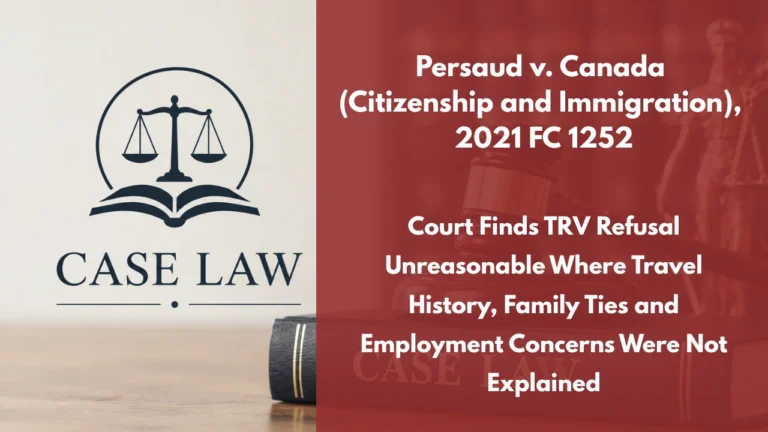
Case Citation:
Persaud v. Canada (Citizenship and Immigration), 2021 FC 1252 (CanLII)
Prepared by:
Dr. Muhammad Abrar (Barrister and Solicitor)
Author | Writer | Mentor | Legal Researcher | Canadian Immigration Case Law and Statistics Analyst