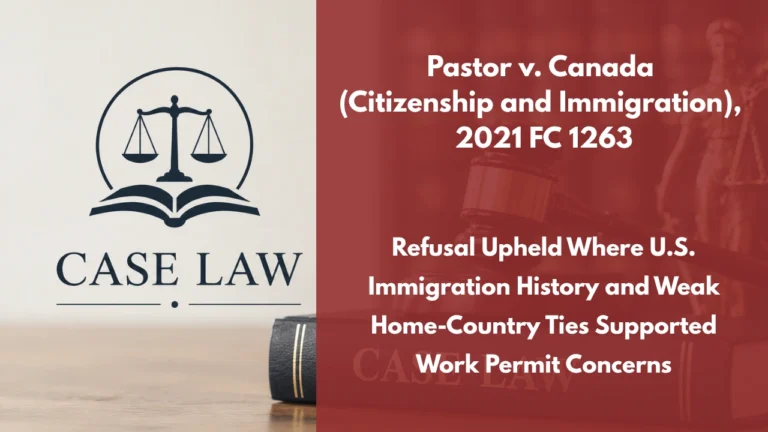
The Federal
Court reviewed IRCC’s refusal of Elpidio Bautista Pastor’s work permit
application. The Mexican citizen had lived and worked unlawfully in the United
States for almost ten years before being deported to Mexico. He later entered
Canada lawfully as a visitor and applied for a work permit supported by a
positive Labour Market Impact Assessment. The officer was not satisfied that he
would leave Canada at the end of his authorized stay. The Court dismissed
judicial review.
Key
Principle
The Federal
Court reaffirmed that a work permit applicant bears the burden of satisfying
the officer that they will leave Canada at the end of the authorized period.
Officers may consider immigration history, travel history, purpose of visit,
length of stay, and ties outside Canada. Reasons may be brief where the record
provides a rational basis for the decision.
Background
The
applicant lived and worked without lawful status in the United States from
March 2008 until January 2018. He was married to an American citizen and had
three American citizen children. He worked as a drywall applicator and later
operated a drywall business with his spouse.
In January
2018, he was deported to Mexico. He remained there for about one year before
entering Canada as a visitor in July 2019. His visitor status was extended at
least once.
In September
2020, while in Canada, he applied for a work permit as a drywall applicator
with a positive LMIA.
The officer
refused the application based on travel history, purpose of visit, and length
of proposed stay. The GCMS notes also referred to his unlawful residence in the
United States and prior immigration violations.
Court
Findings
• U.S.
Immigration History Was Relevant
The Court
found that the officer could reasonably rely on the applicant’s history of
living and working unlawfully in the United States for almost ten years. His
prior non-compliance with immigration law was relevant to whether he had
demonstrated that he would leave Canada when required.
• Evidence
of Strong Ties Outside Canada Was Limited
The
applicant argued that his wife and children in the United States created strong
ties requiring his departure from Canada. The Court rejected this because the
record did not establish that he could lawfully re-enter the United States
after deportation. His ties to Mexico were also weakly documented. He had spent
only about one of the previous twelve years there, and there was no evidence of
property or significant material ties in Mexico.
• Brief
Reasons Were Sufficient in Context
The Court
acknowledged that the officer’s reasons were sparse but held that brevity alone
did not make them unreasonable. The record showed awareness of the applicant’s
unlawful U.S. residence, deportation, limited time in Mexico, and length of
stay in Canada. Given the applicant’s burden and the discretion afforded to
visa officers, the reasons provided a sufficient basis for refusal.
Outcome
The Federal
Court dismissed the application for judicial review. The Court found that the
officer reasonably concluded that the applicant had not established sufficient
ties showing that he would leave Canada at the end of his authorized stay. No
question of general importance was certified.
Case Citation:
Pastor v. Canada (Citizenship and Immigration), 2021 FC 1263 (CanLII)
Prepared by:
Dr. Muhammad Abrar (Barrister and Solicitor)
Author | Writer | Mentor | Legal Researcher | Canadian Immigration Case Law and Statistics Analyst