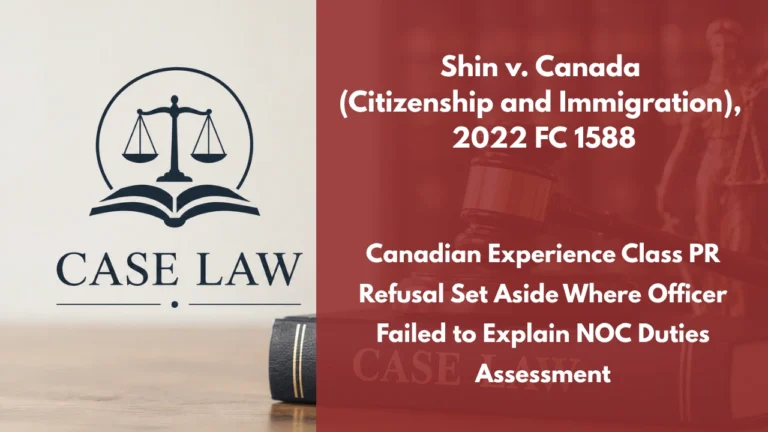
The Federal Court reviewed
Jungwoo Shin’s refusal for PR under the Canadian Experience Class. The officer
concluded that his employment with the Korea Trade Investment Promotion Agency
did not satisfy the lead statement and duties of NOC 4163. The Court found the
decision unreasonable because the officer stated that conclusion without
explaining how the evidence failed to meet the occupational requirements.
Key Principle
A Canadian Experience Class
refusal based on failure to perform the duties of a claimed NOC must contain a
discernible analysis connecting the employment evidence to the occupational
requirements. A bare statement that the applicant did not perform the lead
statement or a substantial number of main duties is insufficient where evidence
describing those duties was submitted.
Background
The applicant studied in Canada
and obtained undergraduate and Master’s degrees. He later worked full-time as a
Business Development Specialist with KOTRA in Toronto. After three earlier PR
refusals for different deficiencies, he applied again relying on his KOTRA
employment under NOC 4163.
Court Findings
• Applicant Submitted Evidence
Describing His Employment Duties
The applicant provided evidence
concerning the duties he performed at KOTRA. The officer therefore had to
assess those duties against the claimed occupational description. The issue was
not an absence of evidence, but whether the reasons demonstrated a rational
evaluation of the evidence actually submitted.
• Officer Reached a General
Conclusion Without Analysis
The officer stated that the
applicant had not performed the actions described in the NOC lead statement or
a substantial number of the main duties, including essential duties. The
reasons did not identify which duties were missing, what evidence was rejected,
or why his responsibilities failed to satisfy the occupational description.
• NOC Assessment Required an
Evidentiary Connection
The governing criteria required
performance of the actions in the lead statement and a substantial number of
the main duties, including all essential duties. Because the refusal turned on
these requirements, the reasons needed to connect the employment evidence to
those criteria rather than repeat the statutory language and announce
non-compliance.
• Lack of Explanation
Prevented Meaningful Review
The Court characterized the
reasoning as a conclusion without explanation. Without a disclosed line of
analysis, neither the applicant nor the Court could understand how the evidence
led to refusal. The absence of transparency and intelligibility was inconsistent
with reasonableness review.
• Earlier Refusals Did Not
Cure the Defective Reasons
The applicant’s three earlier CEC
refusals involved an incorrect NOC code, duties connected to another part-time
job, and a missing KOTRA employment letter. Those earlier matters did not
relieve the officer of the obligation to assess the evidence filed with the
current application and explain the basis for refusal.
• Procedural Fairness Issue
Did Not Need Determination
The applicant also argued that
the officer effectively made a credibility finding without giving him an
opportunity to respond. The Court found it unnecessary to decide that issue
because the lack of meaningful reasons was sufficient to dispose of the application.
The case succeeded on unreasonableness alone.
Outcome
The Federal Court granted
judicial review, set aside the PR refusal, and remitted the application to a
different officer for redetermination. No question was certified.
Case
Citation:
Shin v. Canada (Citizenship and Immigration), 2022 FC 1588 (CanLII)
Prepared by:
Dr. Muhammad Abrar (Barrister and Solicitor)
Author | Writer | Mentor | Legal Researcher | Canadian Immigration Case Law and Statistics Analyst