Ø Introduction
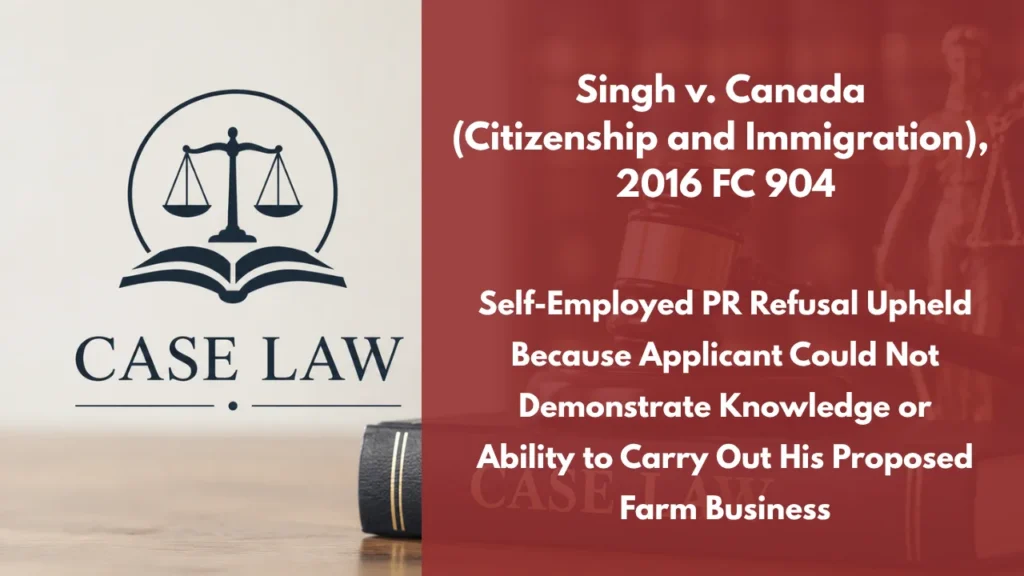
The Federal Court reviewed the refusal of a permanent
residence application under the Self-Employed Persons Class.
The applicant had extensive farming experience in India and
intended to establish a blueberry farm in British Columbia. The Court upheld
the refusal because the officer reasonably found that he lacked sufficient
knowledge of Canadian farming practices and could not explain or demonstrate
the viability of his proposed business.
Ø Key Principle
For the Self-Employed Persons Class, an applicant must
demonstrate both the intention and ability to become self-employed in Canada
and make a significant contribution to specified economic activities.
Previous experience alone is not sufficient. An officer may
examine an applicant’s business plan, knowledge of the proposed Canadian
business environment, research, finances, and ability to carry out the proposed
venture.
Ø Background
The applicant was a 45-year-old farmer from India who had
spent decades cultivating vegetables, wheat, and dairy animals on a 30-acre
farm.
He applied under the Self-Employed Persons Class with the
intention of establishing a blueberry farm in British Columbia. He argued that
he had extensive farming experience, substantial assets, and had hired an
agricultural expert to assist with the proposed venture.
During his interview, however, the officer found that he
knew little about Canadian farming practices, had conducted limited research
into the proposed farm, could not adequately explain his business plan, and had
limited knowledge about his intended location.
The officer therefore concluded that the applicant had not
demonstrated the intention and ability to purchase and manage a farm in Canada.
Ø Court Findings
The Federal Court found that the officer’s decision was
reasonable.
The Court emphasized that the applicant’s previous
farming experience in India did not automatically establish his ability to
operate the proposed Canadian farming business. The officer was entitled to
question his knowledge of farming conditions in British Columbia and his
understanding of the business he proposed to establish.
The Court found that the officer reasonably considered the
applicant’s limited knowledge of the proposed location, the vagueness of his
business plan, his lack of relevant Canadian farming research, and his
inability to adequately explain the strategies contained in his plan.
The Court also rejected the argument that the applicant’s
inability to make an exploratory visit to Canada made the officer’s concerns
unreasonable. An exploratory visit was not mandatory, but the applicant still
had to demonstrate sufficient knowledge and preparation through other means.
The Court further found that his claimed net worth did not
resolve the concerns because much of the value was in agricultural property in
India, while the proposed Canadian farm purchase involved more than simply the
stated down payment.
The Court also rejected the allegation of bias. A high
refusal rate, without reliable evidence establishing its source or context, was
insufficient to demonstrate actual or apprehended bias.
Ø Outcome
The Federal Court dismissed the application for judicial
review and upheld the refusal under the Self-Employed Persons Class.
Case Citation:
Singh v. Canada (Citizenship and Immigration), 2016 FC 904 CanLII
Written by:
Dr. Muhammad
Abrar (Barrister and
Solicitor)
Author | Writer | Mentor | Legal Researcher | Canadian Immigration Case Law and
Statistics Analyst