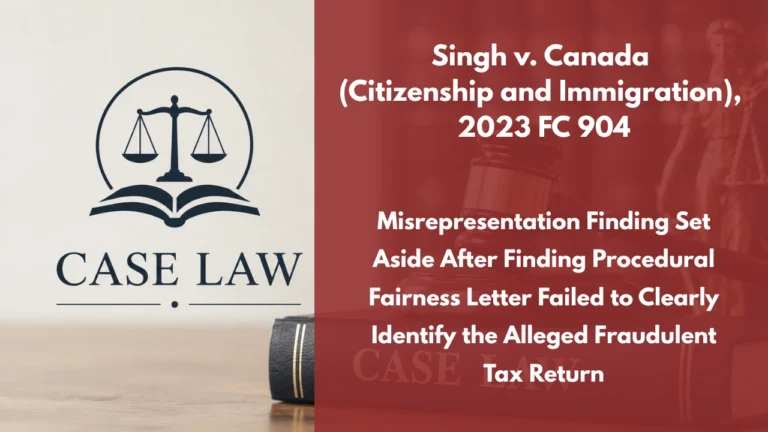
The Federal Court reviewed a
misrepresentation finding arising from Manmeet Singh’s family eTA application.
An officer concluded that an Indian income tax return submitted to demonstrate
available funds was fraudulent. The Court granted judicial review because the
procedural fairness letter did not explain why the document was considered
fraudulent, preventing the applicant from meaningfully responding to the
allegation.
Key Principle
Where an immigration officer
raises a serious allegation of document fraud or misrepresentation, procedural
fairness requires the applicant to know the specific basis of the concern.
Merely stating that a document was “verified and confirmed fraudulent” is
insufficient where the actual concern arose from a particular verification
problem, such as an unreadable barcode, that the applicant could potentially
explain or address.
Background
The applicant, his wife, and two
children sought eTAs for a short visit to Canada and submitted employment,
banking, and tax documents. The officer issued a PFL stating that the
applicant’s 2022-2023 income tax return had been verified and found fraudulent.
The applicant responded and provided further documentation, but a delegated
decision-maker ultimately found him inadmissible for misrepresentation.
Court Findings
• PFL Did Not Identify the
Actual Fraud Concern
The internal GCMS notes showed
that the officer’s fraud conclusion was based on visual checks and the
inability to scan the tax return’s barcode. However, the PFL disclosed only
that the document had been verified and found fraudulent, without explaining
the barcode issue or the nature of the verification.
• Applicant Needed Sufficient
Particularity to Respond Meaningfully
The Court held that a PFL must
provide more than a general allegation. It must identify the officer’s concern
with enough clarity and detail to allow the applicant to provide a meaningful
response, particularly where a serious misrepresentation finding is possible.
• Critical Information Was
Revealed Only After Refusal
The applicant learned that the
barcode problem formed the basis of the fraud concern only after receiving the
GCMS notes associated with the refusal and commencing judicial review. The
Court found that this information should have been disclosed before the
decision so the applicant could attempt to answer it.
• Fraud Finding Was Based Only
on Limited Visual Verification
Unlike cases where allegedly
fraudulent financial documents were independently verified with the issuing
institution, there was no indication that the officer contacted Indian tax
authorities. The concern appeared to arise solely from visual checks and the
barcode issue, which strengthened the need for meaningful disclosure.
• Higher Fairness Was Required
Because of Misrepresentation Consequences
Although procedural fairness in
visa matters is generally limited, the Court noted that greater fairness is
required where misrepresentation is alleged because of the serious consequences
attached to such a finding. The applicant therefore had to receive a genuine
opportunity to know and answer the case against him.
• Incomplete Tribunal Record
Was Also Concerning
A significant GCMS note
explaining how the tax return was found fraudulent was missing from the
certified tribunal record. The Court accepted the note into consideration and
observed that its omission could have impaired both the applicant’s
understanding of the refusal and the Court’s ability to review it.
Outcome
The Federal Court granted
judicial review and remitted the matter to a different officer for
redetermination, directing that all existing and any new evidence be properly
considered. No question was certified.
Case
Citation:
Singh v. Canada (Citizenship and Immigration), 2023 FC 904 (CanLII)
Prepared by:
Dr. Muhammad
Abrar (Barrister and
Solicitor)
Author | Writer | Mentor | Legal Researcher | Canadian
Immigration Case Law and Statistics Analyst