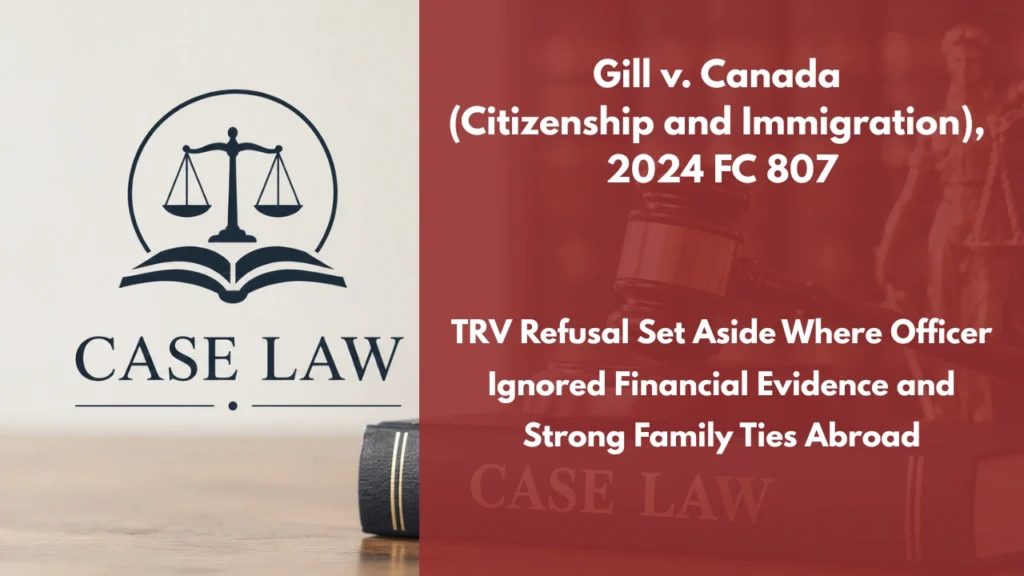
The Federal Court reviewed the
refusal of Kanwarpal Singh Gill’s TRV application for a four-week visit with
two siblings in Canada. The officer relied on insufficient finances, stronger
Canadian family ties, limited ties abroad, and an allegedly non-temporary
purpose. The Court granted judicial review because the reasons did not address
evidence contradicting the financial and family-ties findings.
Key Principle
A visa officer may provide
concise reasons, but they must remain responsive to material evidence. Where an
applicant submits business, financial, asset, and family-tie evidence, the
officer must explain why those factors do not establish financial capacity or
incentives to return. A reference to recent deposits, without questioning
authenticity or reliability, is ordinarily a sufficiency concern rather than a
credibility finding.
Background
The applicant planned to visit
his brother and sister for four weeks. Two other siblings and his aging parents
remained abroad.
He submitted evidence that he
co-owned a business, held approximately CAD $11,000, owned other assets, and
could receive support from his brother. The officer nevertheless found his
finances insufficient and his Canadian ties stronger.
Court Findings
• Financial Evidence Was Not
Assessed Holistically
The officer focused on recent
large deposits but did not address the applicant’s business ownership, savings,
assets, or available family support. Because this evidence contradicted the
finding of insufficient financial establishment, the officer had to explain why
the trip remained an unreasonable expense.
• Strong Family Ties Abroad
Were Overlooked
The applicant had two siblings
and aging parents abroad, together with business and property interests. The
officer mentioned his siblings in Canada but did not explain why the close
relatives and economic connections abroad were insufficient incentives to
return.
• Return and Overstay Factors
Were Not Properly Balanced
A temporary-intent assessment
requires weighing factors encouraging an applicant to remain against those
pulling the applicant home. The reasons did not show that this balancing
occurred because the evidence favouring return was largely absent from the analysis.
• Brief Reasons Still Had to
Address Contrary Evidence
The Court accepted that visa
officers handle high application volumes and need not provide lengthy reasons.
However, concise reasons must still engage with central evidence directly
contradicting the refusal grounds, particularly concerning finances and family
ties.
• Recent Deposits Did Not
Create a Credibility Issue
The notation about recent large
deposits was a factual observation from the bank statements. The officer did
not state that the funds or documents were false or unreliable, so the concern
related to sufficiency and did not trigger procedural fairness.
• Omissions Made the Decision
Unreasonable
The failure to address the full
financial picture and substantial ties abroad made the reasoning difficult to
understand. The decision therefore failed to respect the factual record and
lacked transparency, intelligibility, and justification.
Outcome
The Federal Court granted
judicial review and returned the TRV application to a different officer for
reconsideration. No costs were awarded and no question was certified.
Case Citation:
Gill v. Canada (Citizenship and Immigration), 2024 FC 807 (CanLII)
Prepared by:
Dr. Muhammad
Abrar (Barrister and
Solicitor)
Author | Writer | Mentor | Legal Researcher | Canadian Immigration Case Law and
Statistics Analyst