The Federal Court reviewed the
refusal of Amarachi Justina Obasi’s study permit application for a two-year
Early Childhood Education diploma. The officer found her finances insufficient
and was not satisfied that she would leave Canada after her studies. The Court
granted judicial review because the officer made a veiled credibility finding
about her uncle’s financial support and failed to address significant evidence
of her intention to return.
Key Principle
A study permit officer may assess
whether financial evidence is sufficient, but procedural fairness is engaged
when the officer effectively doubts the genuineness of a claimed family
relationship or the availability of pledged funds. The officer must also
meaningfully address material evidence supporting temporary intent, including
employment leave, a position available upon return, close family ties, and a
concrete career plan.
Background
The applicant had worked as a
childcare giver since 2018 and was admitted to a two-year Early Childhood
Education program. She submitted personal savings, her uncle’s support letter
and bank statement, proof of first-term tuition payment, an employer letter
granting two years of study leave, and evidence of family and career plans
abroad.
Court Findings
• Officer Made a Veiled
Credibility Finding
The officer stated that there was
insufficient evidence establishing the applicant’s relationship with her uncle
and questioned whether his funds would actually be available. Since the record
contained a signed support letter and the applicant’s own statement confirming
the relationship, the concern went beyond evidentiary sufficiency and
implicitly questioned whether the relationship and financial commitment were
genuine.
• Procedural Fairness Required
an Opportunity to Respond
When an officer doubts the
authenticity, accuracy, or credibility of information, the applicant must
receive a meaningful opportunity to answer the concern. The applicant was never
asked to provide additional proof of the family relationship, clarify the
uncle’s commitment, or explain why the pledged funds would remain available
throughout her studies.
• Financial Evidence Was Not
Assessed as a Whole
The applicant submitted
substantial personal funds, her uncle’s sizeable bank balance, a support
letter, and proof that the first academic term had already been paid. The
officer did not explain why this combined evidence failed to establish
sufficient resources for tuition, living expenses, and the duration of the
proposed program.
• Strong Employment and Career
Ties Were Ignored
The applicant’s employer granted
her a two-year study leave and confirmed that she would be welcomed back after
graduation. Her proposed studies were directly connected to her existing
childcare work and her stated plan to manage the Montessori academy established
by her mother.
• Family Ties Supporting
Return Were Overlooked
The applicant lived with her
mother and one sibling and described a continuing family role in her home
country. The officer did not explain why these relationships, together with her
career plans and existing employment, failed to provide meaningful incentives
to return.
• Temporary-Intent Conclusion
Lacked Coherent Reasoning
The officer relied almost
entirely on concerns about the uncle’s financial support to conclude that the
applicant would not leave Canada. The reasons did not weigh the contrary
employment, family, and career evidence or explain why those factors were insufficient,
leaving the decision unsupported and unintelligible.
Outcome
The Federal Court granted
judicial review and set aside the study permit refusal. No question was
certified.
Case Citation:
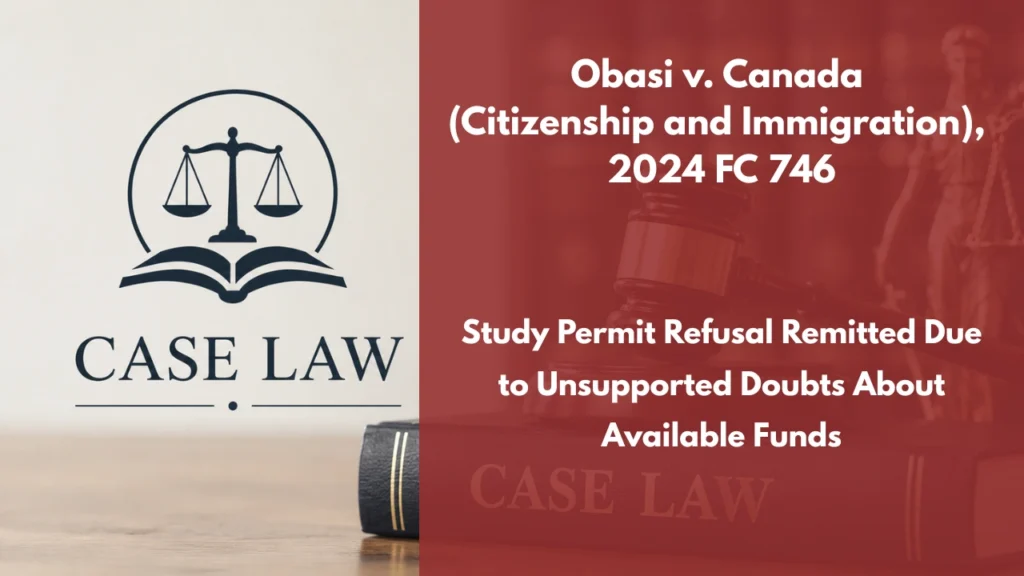
Obasi v. Canada (Citizenship and Immigration), 2024 FC 746 (CanLII)
Prepared by:
Dr. Muhammad
Abrar (Barrister and
Solicitor)
Author | Writer | Mentor | Legal Researcher | Canadian Immigration Case Law and
Statistics Analyst