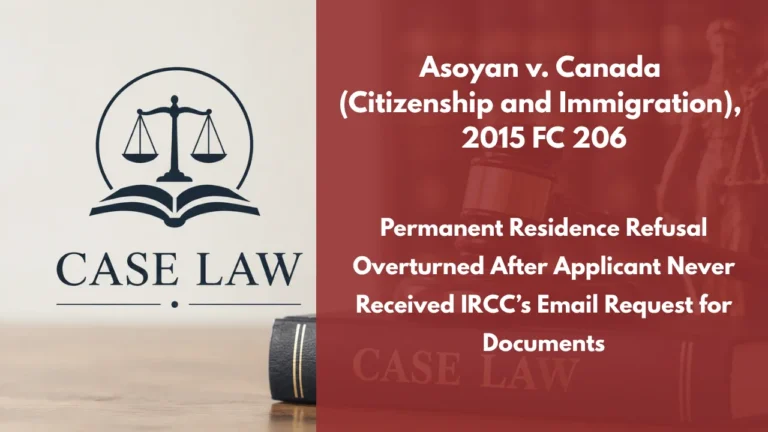
The Federal Court reviewed the refusal of a permanent
residence application after the applicant failed to provide documents requested
by email.
The applicant maintained that she never received the email
containing the document request. Importantly, during the period in which IRCC
expected a response, she had contacted IRCC because she had not even received
an earlier acknowledgment confirming receipt of her application.
The Court found that this should have alerted IRCC to a
possible communication problem. Refusing the application without taking
reasonable steps to confirm that the document request had actually reached the
applicant was procedurally unfair.
Key Principle
An applicant normally has a responsibility to monitor the
contact information provided to IRCC and respond to requests.
However, where IRCC has information suggesting that its
emails may not be reaching the applicant, it cannot simply assume
delivery and penalize the applicant for failing to respond.
In those circumstances, the risk of failed communication may
shift back to IRCC, requiring reasonable steps to confirm or repeat the
communication before refusing the application.
Background
The applicant, a citizen of Armenia, applied for permanent
residence in November 2012 and provided a valid Yahoo email address for
immigration correspondence.
According to GCMS notes, IRCC emailed her in February 2013
requesting updated application forms and a Schedule A Background/Declaration
within 30 days.
The applicant said she never received that email.
During the same 30-day period, she contacted IRCC because
she had also not received the acknowledgment of receipt for her permanent
residence application. IRCC then forwarded her the earlier acknowledgment that
had supposedly already been sent.
Several months later, her permanent residence application
was refused because she had not submitted the documents requested in the
February email.
Court Findings
The Court focused on the fact that IRCC had received a clear
warning that its email communications were not reaching the applicant.
The applicant had contacted IRCC specifically because she
had not received her acknowledgment of receipt. That inquiry occurred while the
deadline for responding to the missing document request was still running.
The Court found that this circumstance should have alerted
IRCC that the February document request might also not have been received.
Once IRCC had such an indication, it was unfair to simply
rely on the absence of a “bounce-back” notification and assume that the
applicant had received the request.
The Court also discussed the inherent unreliability of email
communication. Unlike a successful fax transmission, an email being sent does
not necessarily establish that it was delivered to or read by the intended
recipient.
The Court suggested that, for important immigration
communications, IRCC should make reasonable use of available safeguards such as
delivery or read-receipt mechanisms. Where no acknowledgment is received,
sending the message again may be an appropriate minimum safeguard.
The decision therefore does not mean that every
applicant can overcome a refusal simply by saying that an email was not
received.
The important fact in this case was that IRCC already had
objective information suggesting that its communications to this applicant were
failing.
Outcome
The Federal Court allowed the application for judicial
review and set aside the refusal of the permanent residence application.
Case Citation:
Asoyan v. Canada (Citizenship and Immigration), 2015 FC 206 CanLII
Prepared by:
Dr. Muhammad
Abrar (Barrister and
Solicitor)
Author | Writer | Mentor | Legal Researcher | Canadian Immigration Case Law and
Statistics Analyst