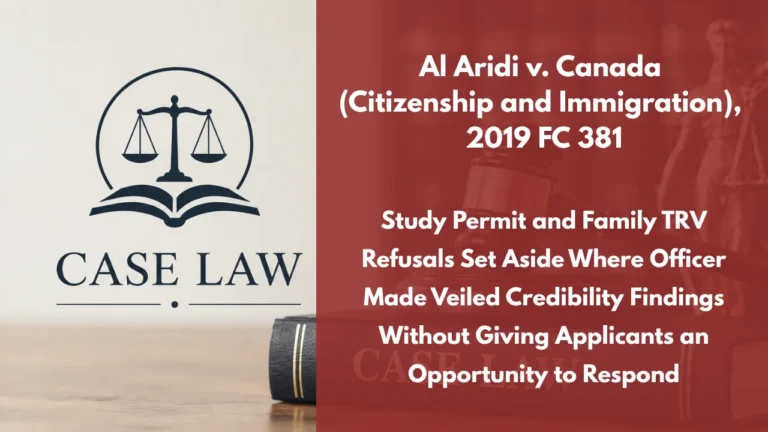
In this case, the Federal Court reviewed the refusal of a
study permit application together with the related Temporary Resident Visa
applications of the applicant’s husband and three children.
The principal applicant wished to pursue a three-year
Special Care Counselling program in Montréal. The officer was not satisfied
that she was a bona fide student or that the family would leave Canada at the
end of the authorized period. The Court found that these concerns amounted to veiled
credibility findings and that procedural fairness required the applicants
to be given an opportunity to respond.
Key Principle
Visa and study permit applicants are generally owed a
relatively low level of procedural fairness, and officers are not required to
alert applicants merely because the evidence submitted is insufficient.
However, the situation changes where an officer’s concern is
really about the credibility, accuracy, authenticity, or genuineness of the
applicant’s evidence or stated intentions.
Where an officer does not simply find the evidence
insufficient, but instead effectively concludes that the applicant is not
telling the truth about the purpose of travel or intention to leave Canada, the
applicant must normally be given an opportunity to address that concern.
Background
The applicants were Lebanese citizens living in Qatar. The
principal applicant had been accepted into a three-year Special Care
Counselling program at Collège LaSalle and held the required Québec acceptance
certificate.
Her husband was employed as a manager with an engineering
firm in Qatar. The family had substantial savings, owned four properties in
Lebanon, maintained extended family ties there, and held U.S. visitor visas.
The husband and children intended to accompany the principal
applicant initially and visit her periodically during her studies.
Despite acknowledging approximately $448,000 CAD in
family savings and the husband’s income of approximately $8,900 CAD per
month, the officer concluded that the principal applicant’s establishment
outside Canada was weak, that the proposed studies would not significantly
improve her qualifications or employment prospects, and that she was not a bona
fide student. The other family members were likewise found not to be bona fide
visitors.
Court Findings
The Federal Court found that the refusals went beyond
concerns about evidentiary sufficiency.
The principal applicant had provided evidence of admission
to the college, a Québec acceptance certificate, a study plan, previous
education and employment information, financial resources, and family
establishment outside Canada.
The Court noted that transcripts and official language test
results, which the officer criticized as missing, were not themselves
regulatory requirements. It also found the officer’s conclusions that the
proposed program would not improve the applicant’s qualifications or employment
prospects to be speculative and unsupported by the evidence.
Most importantly, the Court found that the officer had
effectively decided that the family’s stated intentions were not genuine.
Repeated statements that the principal applicant was not a “bona fide” student
and that the family members were not “bona fide” visitors demonstrated that the
officer did not believe their stated intentions.
This was therefore not merely a case of insufficient
documentation. It involved credibility concerns about whether the family
genuinely intended temporary residence in Canada.
The officer was required to give the applicants an
opportunity to respond to those concerns before refusing their applications.
Failing to do so breached procedural fairness.
Outcome
The Federal Court allowed all five applications for
judicial review, set aside the study permit and TRV refusals, and returned
the applications for redetermination by a different officer.
Case
Citation:
Al Aridi v. Canada (Citizenship and Immigration), 2019 FC 381 CanLII
Prepared by:
Dr. Muhammad
Abrar (Barrister and
Solicitor)
Author | Writer | Mentor | Legal Researcher | Canadian Immigration Case Law and
Statistics Analyst