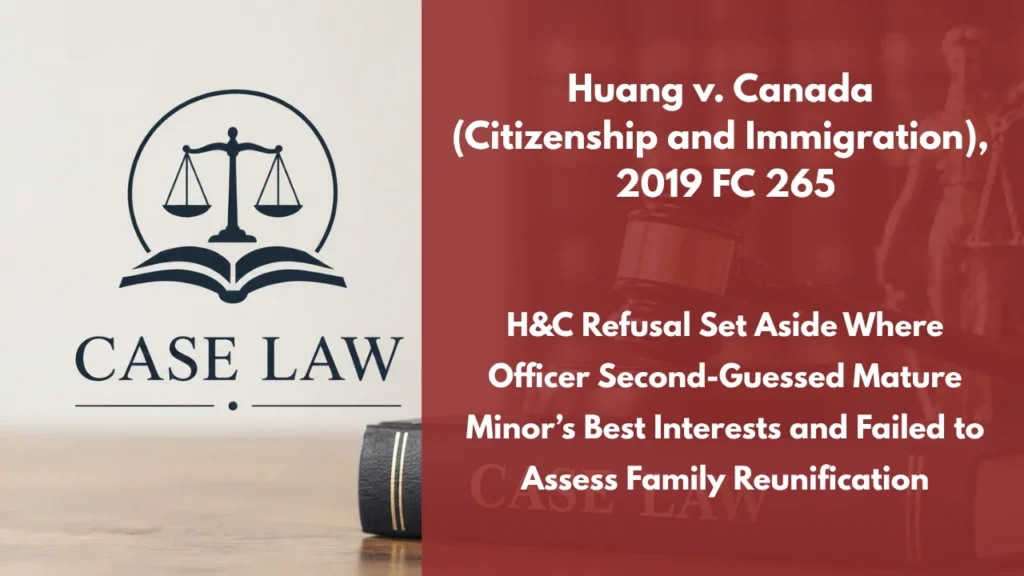
The Federal Court reviewed the refusal of an application for
permanent residence on humanitarian and compassionate grounds involving a young
woman who had been separated for many years from the woman who had raised her
as a daughter.
The central issue was whether the officer could substitute
speculative assumptions about what would be best for the applicant over the
applicant’s own clearly expressed wish to reunite with her de facto mother in
Canada. The Court found that approach unreasonable.
Key Principle
When assessing the best interests of a mature minor,
an immigration officer must give significant weight to the individual’s own
views, having regard to their age and maturity.
An officer is not required to simply accept those views.
However, it is unreasonable to replace the mature applicant’s expressed
understanding of their own best interests with speculative and unsupported
assumptions.
H&C applications must also be assessed globally and
cumulatively, including the benefits of family reunification, emotional
hardship caused by prolonged separation, and the applicant’s particular
personal circumstances.
Background
The applicant was abandoned as a newborn in China and was
found and raised by Ms. Luo, who treated her as her own daughter. A formal
adoption was never completed because Ms. Luo did not meet the applicable age
requirement at the time.
Ms. Luo later immigrated to Canada without declaring the
applicant. The applicant remained in China and eventually lived alone in an
apartment purchased for her by Ms. Luo.
Shortly before turning 18, she applied for permanent
residence. Although she could not qualify as a dependent child under the family
class because there was no biological or formal adoptive relationship, she
requested H&C relief based largely on her close de facto parent-child
relationship with Ms. Luo and their prolonged separation.
Court Findings
The officer recognized the relationship between the
applicant and Ms. Luo as a strong positive factor but identified several
perceived disadvantages of moving to Canada, including possible language
difficulties, disruption of studies, social isolation, mental health concerns,
and the potential impact on Ms. Luo’s younger children.
The Federal Court found that the officer failed to
meaningfully assess important forward-looking H&C considerations, including
the applicant’s ongoing grief from separation, her sense of abandonment and
alienation, and the fact that reunification would allow her to regain the
family relationship she had lost.
Most importantly, the officer speculated that moving to
Canada might make the applicant’s situation worse despite her clear position
that reunification with Ms. Luo was in her best interests.
The applicant had been nearly 18 when she applied and almost
19 when the decision was made. The Court held that, for a person of that age
and maturity, her own views deserved significant weight. The officer could not
reasonably substitute speculative concerns about language, isolation, and
education for the applicant’s own informed assessment of her circumstances.
Outcome
The Federal Court allowed the application for judicial
review, set aside the H&C refusal, and returned the matter for
reconsideration.
Case
Citation:
Huang v. Canada (Citizenship and Immigration), 2019 FC 265 CanLII
Prepared by:
Dr. Muhammad
Abrar (Barrister and
Solicitor)
Author | Writer | Mentor | Legal Researcher | Canadian Immigration Case Law and
Statistics Analyst