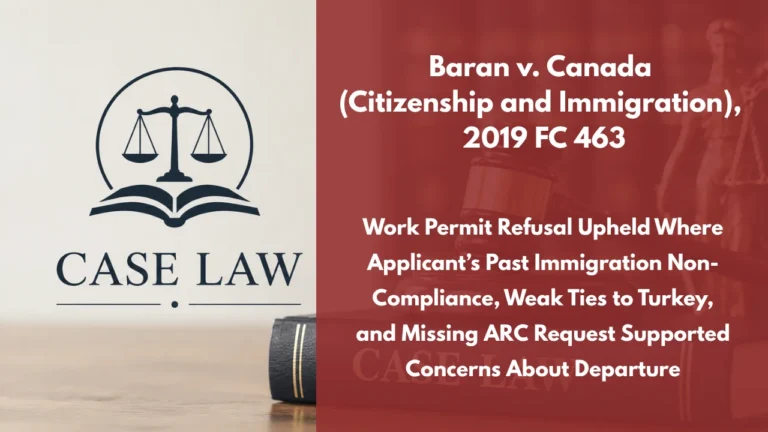
The Federal Court reviewed the refusal of a work permit
application submitted by a Turkish citizen who had previously lived and worked
in Canada, overstayed his authorized stay, pursued several immigration
applications, and ultimately became subject to a deportation order.
Although the applicant later obtained a job offer supported
by a positive LMIA, the officer was not satisfied that he would leave Canada at
the end of his authorized stay and also noted that he had not properly
addressed his need for an Authorization to Return to Canada. The Court upheld
the refusal.
Key Principle
In assessing a work permit application under section 200 of
the IRPR, an officer may consider an applicant’s past immigration history,
previous non-compliance, efforts to remain in Canada, financial establishment
abroad, and overall ties to the home country when determining whether the
applicant is likely to leave Canada at the end of the authorized period.
Where an applicant is subject to a prior deportation order,
the need for an Authorization to Return to Canada (ARC) must also be
addressed within the new application.
Background
The applicant previously came to Canada on a work permit and
later remained beyond the validity of that authorization. During his time in
Canada, he pursued permanent residence, a refugee claim, an H&C
application, and inclusion as a dependant in his parents’ family class
application.
His departure order eventually became a deportation order,
and he left Canada in 2012.
Approximately five years later, he sought to return to
Canada to work for his brother’s company as an ironworker. The employer
obtained a positive LMIA, but the work permit application was refused after the
officer concluded that the applicant had weak financial establishment in
Turkey, a significant history of trying to remain in Canada, and insufficient
evidence showing that he would comply with the conditions of a new work permit.
Court Findings
The Court upheld the officer’s concerns regarding the
applicant’s ties to Turkey.
Although the applicant had a wife, children, and parents in
Turkey, the record contained limited evidence of his own financial
establishment. His income was modest, his wife was unemployed, and the
financial documentation did not strongly demonstrate that he was economically
established in Turkey.
The Court also held that the officer was entitled to
consider the applicant’s prior immigration conduct, including his previous
overstay and repeated attempts to remain in Canada through different
immigration processes.
The applicant argued that the officer improperly required an
absolute “guarantee” that he would leave Canada. The Court rejected this
interpretation, finding that the reasons, read as a whole, simply reflected the
officer’s conclusion that the applicant had not established that he would
depart as required.
The Court also upheld the officer’s treatment of the ARC
issue.
Because the applicant had previously been deported, he
required authorization before returning to Canada. Although there is no
separate ARC application form, the applicant was expected to address the ARC
requirement through submissions accompanying the work permit application. He
had not done so.
The Court clarified that IRCC guidance stating that
applicants should not submit a separate ARC application did not mean the
applicant could ignore the issue altogether. The applicant still had to explain
why authorization to return should be granted, with the fee payable if
requested.
Outcome
The Federal Court dismissed the application for judicial
review, finding that the officer reasonably considered the applicant’s
immigration history, home-country establishment, likelihood of departure, and
failure to properly address the ARC requirement.
Case
Citation:
Baran v. Canada (Citizenship and Immigration), 2019 FC 463 CanLII
Prepared by:
Dr. Muhammad
Abrar (Barrister and
Solicitor)
Author | Writer | Mentor | Legal Researcher | Canadian
Immigration Case Law and Statistics Analyst