The Federal Court reviewed the refusal of a permanent
residence application under the Start-Up Business Class.
The applicant proposed a mobile software platform connecting
parents with daycares and nursery schools in Southeast Asia. The officer
concluded that she had not established that her participation in the incubator
commitment was primarily for genuine business activity rather than for
obtaining immigration status.
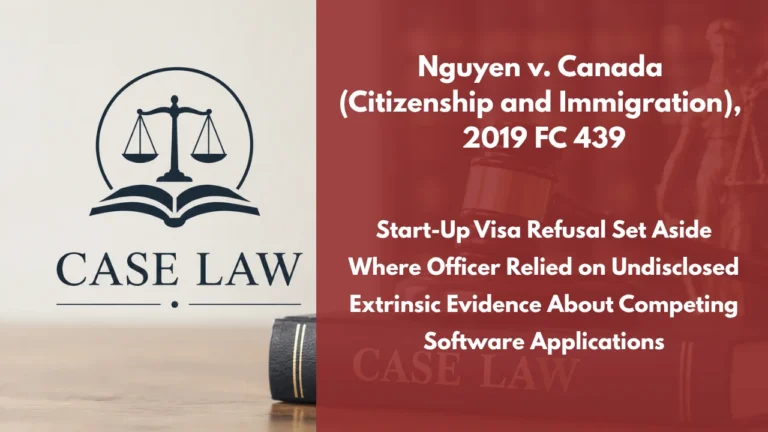
The Court did not decide whether the officer’s substantive
concerns were reasonable. Instead, it set the decision aside because the
officer relied on information about similar software products already existing
in several countries without giving the applicant an opportunity to respond.
Key Principle
Even though the level of procedural fairness owed in visa
applications is relatively low, an applicant must still be given a meaningful
opportunity to know and answer the case against them.
Where an officer relies on extrinsic evidence that may
materially influence the decision, that information must ordinarily be
disclosed to the applicant so that they can respond.
The relevant question is whether facts that were important
or potentially important to the decision were used against the applicant
without providing an opportunity to comment on them.
Background
The applicant, a Vietnamese citizen, applied for permanent
residence through the Start-Up Business Class. Her proposed business involved
developing a global mobile application connecting parents with daycare and
nursery-school providers in ASEAN countries.
A designated business incubator, Empowered Startups Ltd.,
accepted the venture and issued the required commitment certificate.
The officer subsequently requested a peer review. The peer
review panel concluded that Empowered had performed insufficient due diligence,
raising concerns about whether the business idea had been properly validated
and about the proposed development of Natural Language Processing technology.
The officer then issued a Procedural Fairness Letter
identifying concerns about the viability of the business, the lack of evidence
validating the proposed solution, and why the venture had not first been
developed in Vietnam.
Court Findings
The decisive issue was not the fairness of the peer review
itself.
The GCMS notes revealed that the officer had also considered
the fact that similar software applications already existed in the United
States, Vietnam, and Canada.
That concern was not included in the Procedural Fairness
Letter. As a result, the applicant was never given an opportunity to explain
how her proposed product differed from existing applications, whether the
market remained viable, or why the existence of competing products did not
undermine her business plan.
The Court held that this constituted reliance on extrinsic
evidence.
Although officers are not required to disclose every piece
of general information considered during decision-making, procedural fairness
requires disclosure where the information may have a meaningful bearing on the
result.
The Court could not determine how much weight the officer
placed on the existence of competing applications. However, the GCMS notes
showed that the information played at least some role in the assessment.
Because the significance of that undisclosed evidence could
not be measured from the reasons, the Court concluded that the appropriate
remedy was to set aside the refusal and have the application reconsidered by
another officer.
Outcome
The Federal Court allowed the application for judicial
review, set aside the Start-Up Visa refusal, and remitted the application
to a different visa officer for reconsideration.
Case
Citation:
Nguyen v. Canada (Citizenship and Immigration), 2019 FC 439 CanLII
Prepared by:
Dr. Muhammad
Abrar (Barrister and
Solicitor)
Author | Writer | Mentor | Legal Researcher | Canadian
Immigration Case Law and Statistics Analyst