


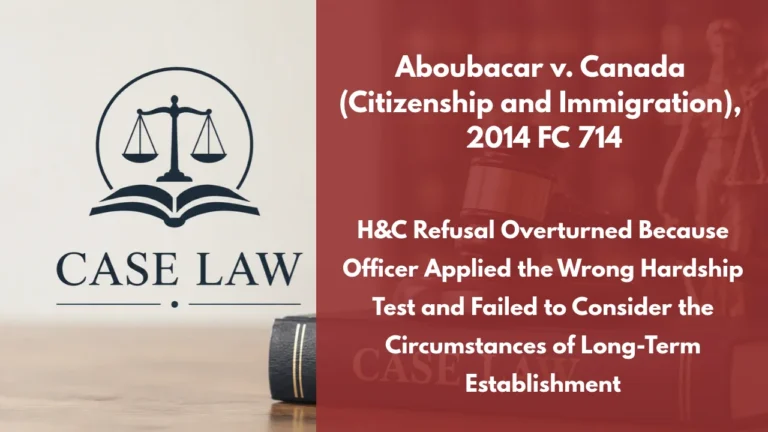
The Federal Court reviewed the refusal of an H&C
application by an applicant who had lived in Canada for approximately 14 years
and whose spousal sponsorship application had remained in process for several
years before being withdrawn.
The Court overturned the decision because the officer
improperly imported the refugee protection test into the H&C analysis and
failed to properly consider the circumstances surrounding the applicant’s
lengthy establishment in Canada.
Key Principle
An H&C officer must assess whether requiring an
applicant to leave Canada and apply for permanent residence from abroad would
cause unusual and undeserved or disproportionate hardship.
The officer cannot require the applicant to demonstrate a
risk or hardship that is different from that faced generally by others in the
country of return. That is a standard associated with refugee protection, not
section 25 H&C relief.
The circumstances that led to an applicant’s establishment
in Canada, including periods during which the applicant reasonably expected to
remain while a spousal sponsorship was being processed, must also be
meaningfully considered.
Background
The applicant was a citizen of Niger who had lived in Canada
for approximately 14 years.
He married a Canadian citizen in 2002, and his wife
sponsored him for permanent residence. The sponsorship received first-stage
approval in 2006, after which he received a work permit and health coverage
while the application remained in process.
The sponsorship application was delayed for approximately
six years before his wife withdrew the sponsorship following their separation
in 2012.
The applicant then applied for permanent residence on
H&C grounds. He relied on his long-term establishment in Canada, including
employment, friendships and community involvement, as well as the hardship he
would face returning to Niger.
The officer acknowledged his establishment but found that it
was not exceptional and concluded that the conditions in Niger affected the
general population and that the applicant had not demonstrated that he would be
personally and directly seriously affected.
Court Findings
The Federal Court found that the officer had applied the wrong
test.
The requirement that an applicant demonstrate hardship or
risk that is not generally faced by others in the country of return comes from
the refugee protection framework. It is not the test under section 25.
The proper question was whether returning this particular
applicant to Niger after approximately 14 years in Canada would cause unusual
and undeserved or disproportionate hardship.
The Court also found that the officer failed to properly
consider the applicant’s establishment and the circumstances in which it
developed.
The applicant had remained in Canada for years while his
spousal sponsorship was being processed. Although he did not have a legal
guarantee of permanent residence, the applicable administrative policy provided
for a deferral of removal and permitted him to work while the sponsorship
application was being processed.
The officer could not simply characterize the applicant’s
continued presence in Canada as a voluntary choice and disregard the
consequences of the lengthy processing delay.
The Court also found that the officer’s assessment of
conditions in Niger was not properly connected to the applicant’s
circumstances. The officer acknowledged severe conditions in Niger but then
concluded that they were common to the general population. This failed to
address the actual H&C question.
Outcome
The Federal Court allowed the application for judicial
review, set aside the H&C refusal and returned the application to a
different officer for redetermination.
Case Citation:
Aboubacar v. Canada (Citizenship and Immigration), 2014 FC 714 CanLII
Prepared by:
Dr. Muhammad
Abrar (Barrister and
Solicitor)
Author | Writer | Mentor | Legal Researcher | Canadian Immigration Case Law and
Statistics Analyst
From temporary status to PR, get expert legal help to choose the right immigration pathway.








© 2026 A&M Canadian Immigration Law Corporation | All Rights Reserved.