The Federal Court reviewed the refusal of humanitarian and
compassionate applications made by two Filipino siblings who had travelled to
Canada to be with their terminally ill mother.
Their mother, a participant in Canada’s Live-in Caregiver
Program, died less than two weeks after their arrival. Her permanent residence
application, which listed both children as overseas dependants, was received by
IRCC one day after her death and was consequently withdrawn.
The Court found that the officer approached the H&C
assessment too mechanically and failed to meaningfully consider the
particularly compassionate circumstances surrounding the family’s situation.
Key Principle
An H&C assessment under section 25 of IRPA cannot be
reduced to a checklist of establishment, hardship, family ties, and BIOC.
Officers must assess the particular human circumstances
of the case through a compassionate lens and substantively consider all
relevant factors, even where those factors do not fit neatly within standard
categories.
Where a child is directly affected, the officer must also
remain alert, alive, and sensitive to the child’s best interests, having
regard to the full factual context rather than simply noting conventional
indicators such as length of residence or establishment.
Background
The applicants were a 17-year-old boy and his 23-year-old
sister. Their mother had left the Philippines to participate in Canada’s
Live-in Caregiver Program in the hope of creating a better future for her
children.
After developing terminal breast cancer, she arranged for
her children to receive visitor visas so they could be with her. They arrived
in Canada on November 25, 2016, and she died on December 7, 2016.
Her final wish was that her children remain in Canada and
continue the journey she had begun for them. The applicants later sought
H&C relief, explaining their grief, financial vulnerability, lack of
meaningful parental support in the Philippines, and their desire to fulfil
their mother’s wish.
Court Findings
The Court found that the officer’s analysis was overly
mechanical.
The reasons addressed establishment, family reunification,
hardship, and BIOC as separate categories, but failed to engage with the most
compelling humanitarian elements of the case.
In particular, the officer did not meaningfully consider the
mother’s long-term sacrifice through the Live-in Caregiver Program, her
repeated efforts to obtain permanent residence while listing her children as
dependants, the applicants’ grief following her death, or the significance of
her final wish that they remain in Canada.
The Court was particularly concerned with the analysis of
the minor applicant’s best interests. Although the officer acknowledged that he
was a child, merely noting his familiarity with the Philippines and limited
establishment in Canada did not demonstrate an adequately sensitive BIOC
assessment.
The Court emphasized that these applicants could not
reasonably be expected to demonstrate the usual indicators of establishment,
such as lengthy residence, employment, volunteering, or Canadian education.
Their H&C case arose from an unusual and deeply personal set of
circumstances that required individualized consideration.
By focusing on conventional checklist factors and failing to
meaningfully weigh the broader compassionate evidence, the officer did not
conduct the global assessment required by Kanthasamy.
Outcome
The Federal Court allowed the application for judicial
review, set aside the H&C refusal, and returned the matter for
redetermination by a differently constituted decision-maker.
Case
Citation:
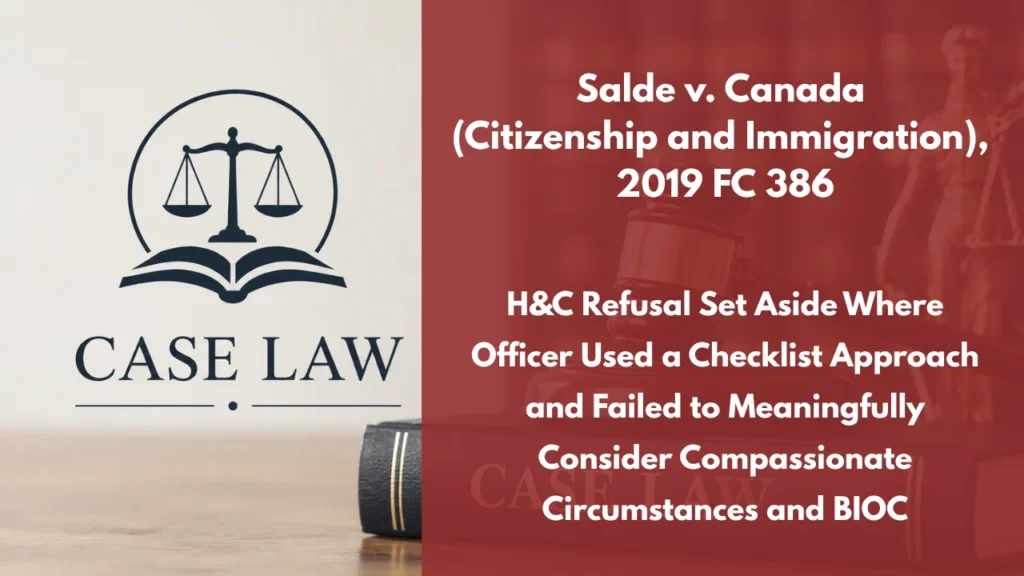
Salde v. Canada (Citizenship and Immigration), 2019 FC 386 CanLII
Prepared by:
Dr. Muhammad
Abrar (Barrister and
Solicitor)
Author | Writer | Mentor | Legal Researcher | Canadian Immigration Case Law and
Statistics Analyst