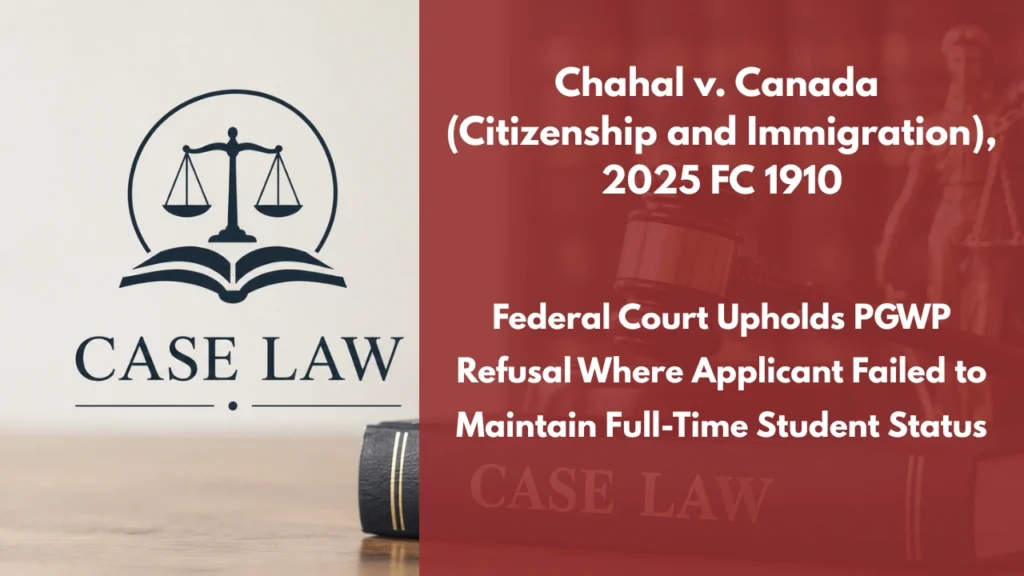
The Federal
Court reviewed IRCC’s refusal of a Post-Graduation Work Permit (PGWP)
application submitted by an international student who had completed his
undergraduate studies in Canada. The application was refused because the
applicant had not maintained full-time student status during each academic
session of his program. Although the officer mistakenly identified the academic
term in the refusal reasons, the Court held that the error was insignificant
because the evidence clearly established that the applicant was not eligible
for a PGWP.
Key Principle
The Federal
Court reaffirmed that PGWP eligibility requirements must be strictly applied.
Applicants must demonstrate that they maintained full-time student status
during each academic session of their program, subject only to specific
exceptions. While officers must provide reasonable decisions, reviewing courts
will not interfere with minor factual mistakes where the overall reasoning
remains logical and the outcome is supported by the evidence.
Background
The applicant, a
citizen of India, entered Canada on a study permit and enrolled in a Bachelor
of Arts (Honours) Criminology program at York University in 2019.
During the
Summer 2020 academic session, the applicant initially enrolled in two courses
totaling nine credits, which met York University’s requirement for full-time
status. However, he later withdrew from one course, leaving him with only three
credits for that session. As a result, he was considered a part-time student.
In June 2024,
the applicant applied for a Post-Graduation Work Permit. His transcript,
submitted with the application, showed the reduced course load. IRCC refused
the application after determining that he had not maintained full-time student
status throughout his program.
Court
Findings
• Applicant
Did Not Meet PGWP Requirements
The Court held
that the applicant did not satisfy the mandatory PGWP eligibility criteria. The
evidence established that he was not enrolled as a full-time student during the
Summer 2020 session. Since full-time status is a required condition for PGWP eligibility,
the refusal was supported by the record.
• Officer’s
Mistake Did Not Make the Decision Unreasonable
The applicant
argued that the officer incorrectly referred to the relevant academic session
as “Fall 2019 Winter 2019” rather than the Summer 2020 session. The Court
accepted that the officer made a mistake but found that it did not affect the
decision.
Justice Brown
emphasized that judicial review is not a search for minor errors. The question
is whether the decision, viewed as a whole, contains a rational chain of
reasoning. In this case, the evidence clearly showed that the applicant had
lost full-time status because of his course withdrawal.
• No
Requirement to Issue a Procedural Fairness Letter
The applicant
argued that the officer should have provided an opportunity to explain his
circumstances or obtain clarification from his university. The Court rejected
this argument, holding that visa officers are not required to provide
applicants with a “running score” of weaknesses in their applications or give a
second opportunity to establish eligibility.
The applicant
bore the responsibility of submitting a complete application demonstrating that
he met the PGWP requirements.
Outcome
The Federal
Court dismissed the application for judicial review. The Court concluded that
although the officer misstated the academic term, the refusal was reasonable
because the applicant did not maintain full-time student status as required for
PGWP eligibility. No question was certified, and no costs were awarded.
Case
Citation:
Chahal v. Canada (Citizenship and Immigration), 2025 FC 1910 (CanLII)
Prepared by:
Dr. Muhammad
Abrar (Barrister and
Solicitor)
Author | Writer | Mentor | Legal Researcher | Canadian
Immigration Case Law and Statistics Analyst