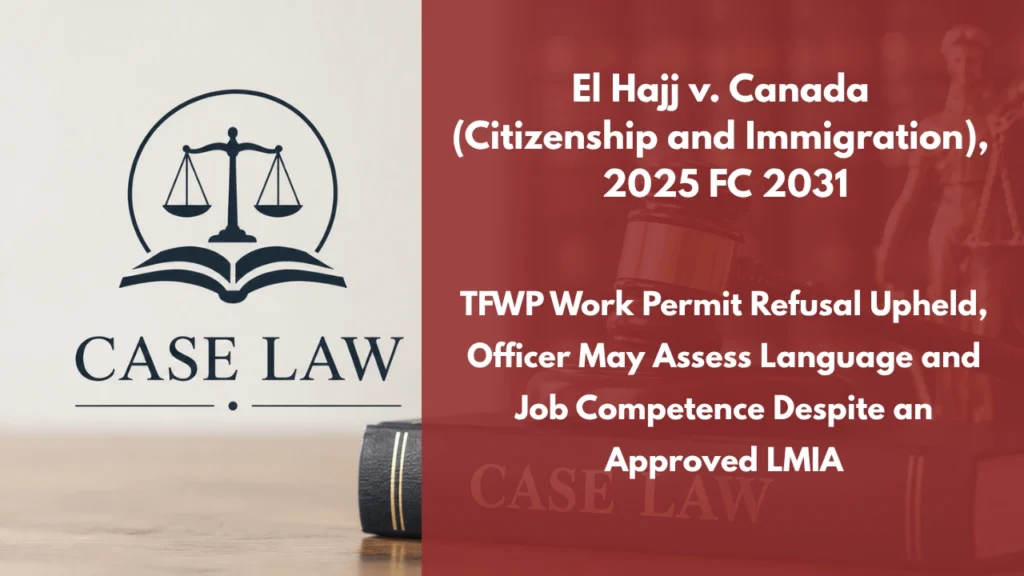
El Hajj concerned a
Lebanese citizen whose Temporary Foreign Worker Program application to work as
a cook at a Lebanese restaurant in Quebec was refused. The officer was not
satisfied that the applicant had demonstrated sufficient cooking qualifications
or language ability. The Federal Court dismissed the judicial review, finding
that the officer meaningfully assessed the evidence, reasonably considered the
applicant’s performance during a telephone interview, and provided an
opportunity through a Procedural Fairness Letter (PFL) to address the concerns.
Key Principle
An approved LMIA does not prevent
an immigration officer from independently assessing whether a foreign national
is capable of performing the proposed employment. Where the NOC and LMIA
identify language or professional requirements, the officer may verify whether
the applicant actually possesses the necessary skills. An applicant bears the
onus of submitting convincing evidence and addressing concerns raised by the
officer.
Background
Mr. El Hajj applied for a TFWP
work permit to work as a cook. His application was initially refused and later
returned for redetermination following judicial review proceedings. The
applicable LMIA required secondary education and written and verbal competency
in either English or French. The applicant initially provided a CV and
employment reference but little documentary evidence of his education or
language abilities.
During a telephone verification
interview, the officer observed that the applicant struggled to communicate and
was unable to adequately describe the food he prepared or demonstrate knowledge
of restaurant and cooking terminology. The officer also independently verified
one employment reference and was told by the alleged employer that the
applicant had never worked there.
A PFL subsequently gave the
applicant an opportunity to provide proof of his education, language abilities
and qualifications. He submitted a hospitality baccalaureate document, expired
IELTS results, an updated CV and an Instagram account showing cooking-related
photographs and videos. The officer found the evidence insufficient and
ultimately refused the application.
Court Findings
• Officer Could Assess
Competence: The Court rejected the argument that the employer was primarily
responsible for assessing competence. Even with an approved LMIA, officers
retain authority to determine whether an applicant satisfies the requirements
necessary to perform the proposed job.
• Language Assessment Was
Reasonable: The officer was entitled to consider the applicant’s telephone
interview, expired IELTS results and limited documentary evidence. The LMIA
required proficiency in English or French, and the NOC duties of a cook
involved communication relevant to food safety, customers and workplace
requirements.
• Employment Evidence Was
Properly Scrutinized: The officer reasonably discounted claimed experience
after verification with an alleged employer produced a negative result. The
Court also found that the officer had meaningfully considered the remaining
employment evidence.
• Fair Process: Although
the officer’s attempts to arrange another interview could have been handled
better, the applicant had already undergone an interview, received a PFL, and
had an opportunity to provide additional evidence. The Court found no fatal
procedural fairness error.
Outcome
The Federal Court dismissed the
judicial review, finding the refusal reasonable and the process fair. The
officer was entitled to conclude that the applicant had not demonstrated the
required language and cooking skills despite the approved LMIA. No question of
general importance was certified.
Case
Citation:
El Hajj v. Canada (Citizenship and Immigration), 2025 FC 2031 (CanLII)
Prepared by:
Dr. Muhammad
Abrar (Barrister and
Solicitor)
Author | Writer | Mentor | Legal Researcher | Canadian
Immigration Case Law and Statistics Analyst