The Federal Court reviewed IRCC’s
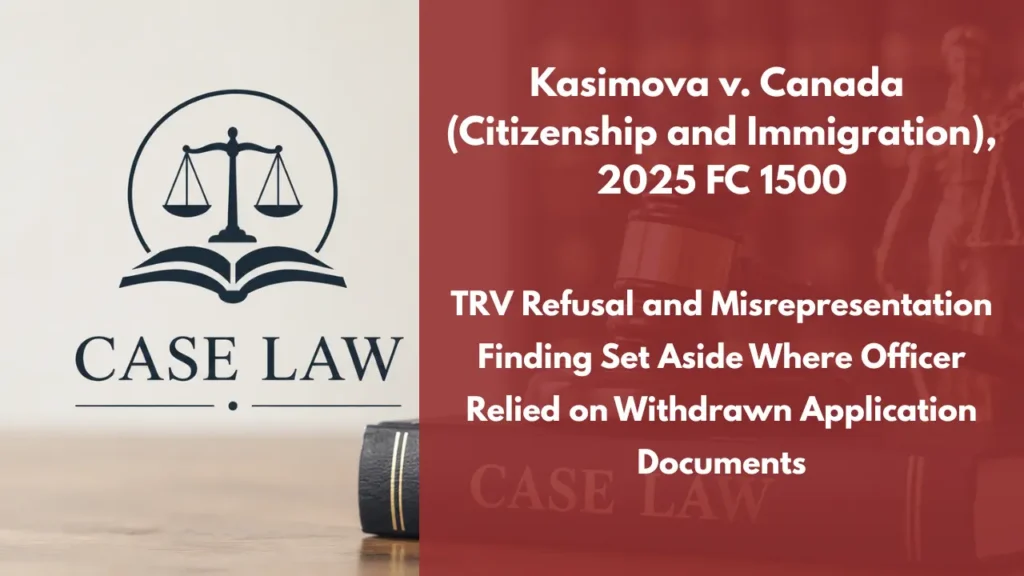
refusal of Dilafruz Bahodir Kizi Kasimova’s temporary resident visa (TRV)
application and the related finding of inadmissibility for misrepresentation.
The officer relied on a bank document submitted in a previous withdrawn
application to question the credibility of the applicant’s financial documents.
The Court granted judicial review, finding that the officer improperly relied
on evidence that was no longer part of the application under review and failed
to assess the evidence actually submitted with the new application.
Key Principle
The Federal Court reaffirmed that
misrepresentation findings carry serious consequences, including a five-year
inadmissibility period, and must be based on a sound evidentiary foundation.
Officers must assess the evidence forming part of the application before them.
They cannot rely on documents from withdrawn applications without proper
justification while ignoring updated evidence submitted in the current
application.
Background
The applicant, a citizen of
Uzbekistan, applied for a TRV while visiting the United States with her two
children. She initially submitted a TRV application in July 2023 but withdrew
it after discovering mistakes and errors in the documents provided, including a
letter from Asia Alliance Bank.
The applicant informed IRCC that
the mistakes were unintentional and that she intended to correct the documents
before reapplying. IRCC confirmed the withdrawal.
In August 2023, the applicant
submitted a new TRV application. She replaced the previous Asia Alliance Bank
letter and added additional financial documentation, including a Bank of
America letter.
During processing, IRCC issued a
procedural fairness letter raising concerns about the credibility of the
applicant’s financial information. The officer later relied on the Asia
Alliance Bank document from the withdrawn application, after verifying it with
the bank and finding it fraudulent.
The officer refused the new TRV
application and found the applicant inadmissible for misrepresentation under
section 40 of IRPA.
Court Findings
• Officer Improperly Relied on
Withdrawn Evidence
The Court found that the
officer’s decision was unreasonable because the alleged fraudulent document was
not part of the application being assessed. The applicant had withdrawn the
previous application and submitted updated documents in the new application.
Justice Brouwer held that the
officer conducted an improper “fishing expedition” by verifying evidence from a
withdrawn application while failing to evaluate the financial documents
actually submitted.
• Current Application Evidence
Was Ignored
The Court found that the officer
failed to assess the updated bank documents and explanations provided by the
applicant. The officer relied on the previous document to undermine credibility
without explaining why the current evidence was insufficient.
• Misrepresentation Findings
Require Careful Analysis
The Court emphasized that
officers must be cautious when making misrepresentation findings because of
their serious and lasting consequences. A document that was withdrawn from an
earlier application could not reasonably form the basis of a misrepresentation
finding in the new application without proper analysis.
Outcome
The Federal Court granted the
application for judicial review, set aside the March 26, 2024 decision, and
remitted the matter to a different officer for redetermination. The applicant
was provided an opportunity to update her application before a new decision. No
question was certified.
Case Citation:
Kasimova v. Canada (Citizenship and
Immigration), 2025 FC 1500 (CanLII)
Prepared by:
Dr. Muhammad Abrar (Barrister and Solicitor)
Author | Writer | Mentor | Legal Researcher | Canadian Immigration Case Law and Statistics Analyst