The Federal Court reviewed IRCC’s
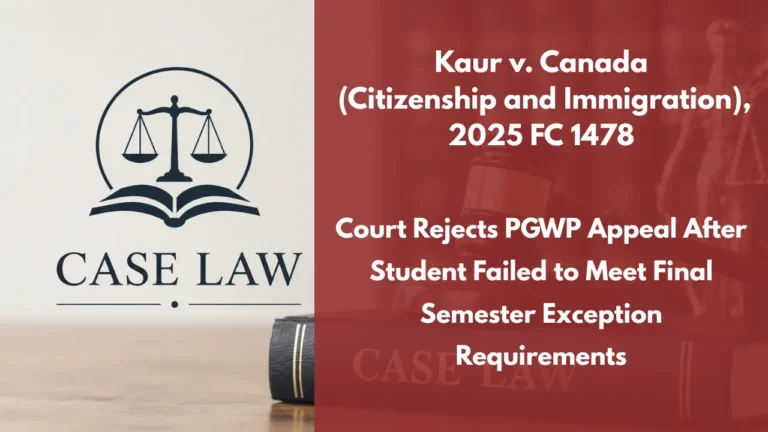
refusal of Simranpreet Kaur’s Post-Graduation Work Permit (PGWP) application.
The applicant completed two one-year certificate programs at Bow Valley College
but was refused a PGWP because the officer found that she did not maintain
full-time student status during her final academic session. The Court dismissed
the judicial review, finding that the officer reasonably concluded the
applicant’s part-time semester was not her final semester for PGWP eligibility
purposes.
Key Principle
The Federal Court reaffirmed that
PGWP applicants bear the burden of demonstrating that they meet all eligibility
requirements. To qualify, applicants must generally maintain full-time student
status during each semester of their program, except during a regularly
scheduled break or the final semester. Courts will defer to reasonable
interpretations by immigration officers where the decision is supported by the
record.
Background
The applicant, a citizen of
India, completed the second of two one-year certificate programs at Bow Valley
College and applied for a Post-Graduation Work Permit.
During the fall 2023 semester of
her second certificate program, the applicant enrolled in only one three-credit
course, resulting in part-time status. She explained that she was repeating the
course to improve her grade point average and qualify for a required field
placement in the following winter semester.
IRCC refused the PGWP
application, finding that the fall 2023 semester was not the applicant’s final
semester or final academic session because she still had the winter 2024 field
placement remaining. Since she had studied part-time outside an accepted exception
period, the officer concluded that she did not meet the PGWP requirements.
Court Findings
• Fall Semester Was Not the
Final Semester
The Court agreed with IRCC that
the applicant’s final academic session was not the fall 2023 semester. The
remaining winter 2024 field placement was a required component of the program
and was necessary for completion.
Justice Fuhrer noted that the
transcript showed the field placement was assigned a course code, course title,
and academic credits. Although the applicant characterized it as a practicum or
co-op term rather than academic study, the record did not support that
distinction.
• Officer’s Reasons Were
Sufficient
The Court held that the brevity
of the officer’s reasons did not make the decision unreasonable. The GCMS notes
clearly explained that the applicant had been part-time during a semester that
was not considered a final semester.
The Court emphasized that
administrative decisions do not require perfect reasons. The question is
whether the reasoning is understandable and supported by the evidence.
• Alternative Interpretations
Did Not Make Decision Unreasonable
The Court accepted that a
different interpretation of the program structure may have been possible.
However, the existence of another reasonable interpretation does not mean the
officer’s decision was unreasonable.
Outcome
The Federal Court dismissed the
application for judicial review. The Court found that the officer reasonably
determined the applicant was not eligible for a PGWP because she did not
maintain full-time student status as required. No question was certified.
Case Citation:
Kaur v. Canada (Citizenship and Immigration),
2025 FC 1478 (CanLII)
Prepared by:
Dr. Muhammad Abrar (Barrister and Solicitor)
Author | Writer | Mentor | Legal Researcher | Canadian Immigration Case Law and Statistics Analyst