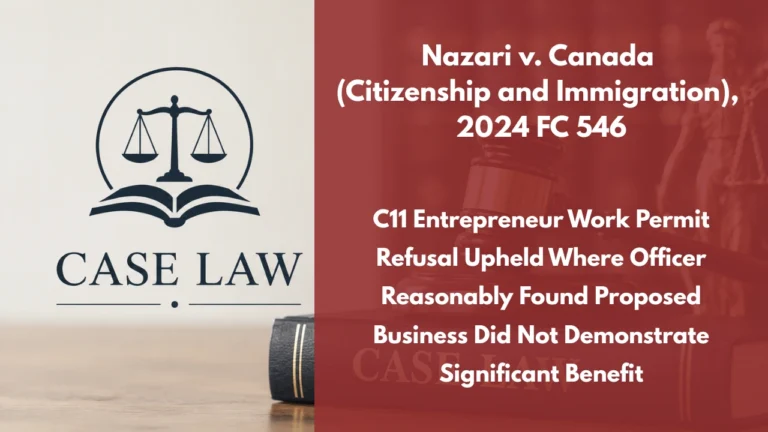
C11 Entrepreneur Work Permit Refusal Upheld Where Officer
Reasonably Found Proposed Business Did Not Demonstrate Significant Benefit
The Federal Court dismissed an application for judicial
review of the refusal of a C11 entrepreneur work permit under paragraph 205(a)
of the Immigration and Refugee Protection Regulations (IRPR). The
applicant, an experienced physician and corporate executive, sought to
establish a specialized health food business in Vancouver and argued that the
visa officer failed to meaningfully consider his extensive business plan. The
Court held that the officer reasonably concluded the applicant had not
demonstrated that the proposed business would create a significant economic
benefit for Canada and had therefore failed to satisfy the requirements for a
C11 work permit. Because the principal applicant’s work permit was refused, the
accompanying spouse’s temporary resident visa was also properly refused.
Key Principle
Applicants seeking a C11 entrepreneur work permit bear the
burden of demonstrating that their proposed business will create or maintain
significant social, cultural, or economic benefits for Canada under paragraph
205(a) of the IRPR. Visa officers are entitled to assess the viability
and competitiveness of the proposed business plan, and the Court will not
reweigh the evidence simply because an applicant disagrees with the officer’s
assessment. A decision will only be unreasonable where the officer overlooks
material contradictory evidence or fails to provide a rational explanation for
the conclusion reached.
Background
The applicant, an Iranian physician and Corporate and
Regulatory Affairs Director of an infant nutrition company, applied for a
Labour Market Impact Assessment (LMIA)-exempt C11 work permit to establish Borna
Venture Inc., a specialized health store in Vancouver focusing on baby
food, sports nutrition, and health food products. In support of the
application, he submitted a detailed 68-page business and financial plan
outlining his professional experience, financial resources, and proposed
business model. The visa officer refused the application, concluding that the
applicant had failed to demonstrate that the business would generate a
significant benefit for Canada or remain competitive in a market already served
by well-established businesses.
Court Findings
• Officers May Assess the Viability and Competitiveness
of a Business Plan
The Court confirmed that visa officers are entitled to
examine whether a proposed business is likely to create a significant benefit
for Canada, including assessing its competitiveness and commercial viability.
It was reasonable for the officer to conclude that the applicant had not
sufficiently demonstrated how his proposed business would compete in an already
well-serviced market.
• Disagreement with the Officer’s Assessment Does Not
Make a Decision Unreasonable
The applicant argued that the officer ignored portions of
the business plan describing the proposed business’s competitive advantages.
The Court rejected this submission, finding that the officer specifically
referred to the proposed business and the competitive market identified within
the business plan. Unlike cases where officers ignore material contradictory
evidence, the officer here considered the evidence but reached a conclusion
different from that urged by the applicant. Judicial review does not permit the
Court to reweigh that evidence.
• Brief Reasons May Still Be Reasonable
The Court emphasized that visa officers processing temporary
resident applications are not required to provide lengthy reasons. Although the
officer’s analysis was concise, it demonstrated awareness of the applicant’s
business proposal and explained why the evidence failed to establish that the
business would provide the significant benefit required under paragraph 205(a)
of the IRPR. The reasons therefore met the standard of justification,
transparency, and intelligibility established in Vavilov.
Outcome
The Federal Court dismissed the application for judicial
review, concluding that the visa officer reasonably determined that the
applicant had failed to demonstrate that the proposed business would generate a
significant benefit for Canada under paragraph 205(a) of the IRPR. As
the principal applicant’s C11 work permit was reasonably refused, the
accompanying spouse’s temporary resident visa refusal also remained valid. The
decision confirms that courts will defer to a visa officer’s assessment of a
business plan where the officer has considered the evidence and provided a
rational explanation for the refusal.
Case Citation:
Nazari v. Canada (Citizenship and Immigration), 2024 FC 546 (CanLII),
Prepared by:
Dr. Muhammad
Abrar (Barrister and
Solicitor)
Author | Writer | Mentor | Legal Researcher | Canadian
Immigration Case Law and Statistics Analyst