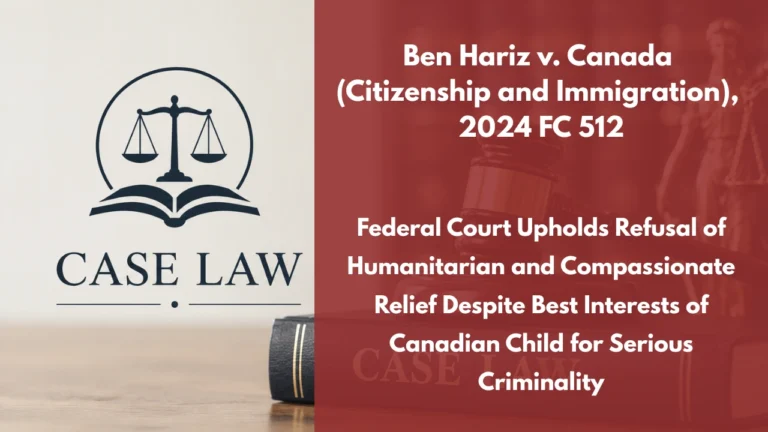
The Federal Court dismissed an
application for judicial review challenging the refusal of humanitarian and
compassionate (H&C) relief under subsection 25(1) of the Immigration and
Refugee Protection Act (IRPA). The applicant, a Tunisian citizen, had been
deported from Canada after being found inadmissible for serious criminality
and later sought an exemption from his inadmissibility to allow his Canadian
citizen spouse to sponsor him for permanent residence. He argued that the
Minister’s Delegate failed to properly assess the best interests of his
Canadian citizen daughter, who would allegedly be separated from one of her
parents if the application were refused. The Court held that the Delegate
reasonably concluded the child’s best interests were served by remaining in
France with both parents and that the family’s circumstances resulted largely
from choices knowingly made after the applicant’s removal from Canada.
Key Principle
When assessing an H&C
application under subsection 25(1) of the IRPA, decision-makers must
give meaningful consideration to the best interests of any child directly
affected by the decision. However, the child’s best interests do not
automatically outweigh all other considerations. Where the circumstances
affecting the child arise primarily from informed decisions made by the
parents, an officer may reasonably conclude that H&C relief is not
warranted. The Court will not interfere where the decision reflects a balanced
and intelligible assessment of the relevant humanitarian factors.
Background
The applicant entered Canada in
2008 but remained beyond his authorized stay and was subsequently convicted of
several criminal offences. Following a finding of serious criminality, he was
removed from Canada in 2019 and relocated to France. There, he married a dual
French-Canadian citizen in 2021, and the couple’s daughter, also a dual
citizen, was born shortly thereafter. The applicant later requested H&C
relief to overcome his inadmissibility so that he could eventually be sponsored
for permanent residence in Canada. He submitted that his wife experienced
significant hardship living outside Canada and that refusing the application
would separate his daughter from one of her parents if the family returned to
Canada. The Minister’s Delegate acknowledged these submissions but concluded
that the family was well established in France, where the applicant held legal
status and had successfully integrated, and that nothing prevented them from
remaining there together.
Court Findings
• Best Interests of the Child
Were Reasonably Assessed
The Court held that the Delegate
properly identified the child’s best interests as remaining in France with both
parents. The daughter had been born in France, had lived there her entire life,
and there was no evidence that remaining in France would adversely affect her
well-being. The Court agreed that the alleged separation from a parent would
occur only if the parents voluntarily chose to relocate to Canada without the
applicant.
• Parents’ Choices Were a
Relevant Consideration
The Court emphasized that the
applicant’s inadmissibility was known before the marriage and before the birth
of the child. The family’s current circumstances resulted primarily from
informed decisions made by the parents rather than unforeseen hardship. While
officers must consider the interests of affected children, parents also bear
responsibility for making decisions that promote those interests.
• The Refusal Was Reasonable
The Court concluded that the
Minister’s Delegate considered all relevant humanitarian factors, including the
applicant’s family circumstances and the best interests of the child, before
determining that they did not justify exempting the applicant from the
consequences of his serious criminality. The decision was transparent,
intelligible, and consistent with the principles governing H&C relief under Kanthasamy.
Outcome
The Federal Court dismissed the
application for judicial review, finding that the Minister’s Delegate
reasonably refused humanitarian and compassionate relief. The decision confirms
that while the best interests of a child are an important consideration in
H&C applications, they are not determinative where the evidence
demonstrates that the child’s welfare is protected and the family’s hardship
results primarily from choices knowingly made by the parents.
Case Citation:
Ben Hariz v. Canada (Citizenship and
Immigration), 2024 FC 512 (CanLII)
Prepared by:
Dr. Muhammad
Abrar (Barrister and
Solicitor)
Author | Writer | Mentor | Legal Researcher | Canadian
Immigration Case Law and Statistics Analyst