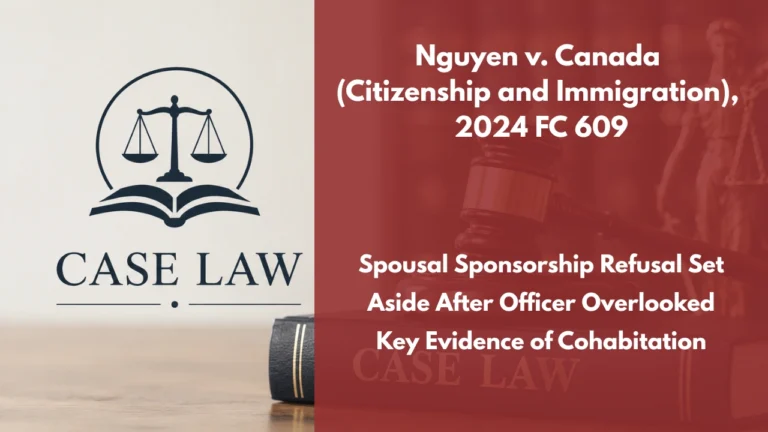
The Federal Court allowed an application for judicial review
of the refusal of a permanent residence application under the Spouse or
Common-Law Partner in Canada Class. The immigration officer concluded that the
applicant had entered into the marriage primarily to obtain immigration status
and had failed to establish that he cohabited with his Canadian spouse. While
the Court upheld the officer’s assessment regarding the primary purpose of the
marriage, it found the decision unreasonable because the officer overlooked
objective documentary evidence directly supporting cohabitation. The Court held
that where an officer disregards material evidence central to the determination
of eligibility without explanation, the resulting decision cannot satisfy the
standard of reasonableness.
Key Principle
Although applicants bear the burden of establishing that a
marriage is genuine and was not entered into primarily for an immigration
advantage, immigration officers must meaningfully consider all material
evidence relating to the statutory requirements. Where evidence directly
contradicts an officer’s conclusion on a central issue, the officer must
explain why that evidence was rejected. A failure to address objective evidence
of cohabitation renders a decision unreasonable.
Background
The applicant, a citizen of Vietnam, entered Canada as an
international student and later married his Canadian spouse in April 2021. He
subsequently applied for permanent residence under the Spouse or Common-Law
Partner in Canada Class. During processing, IRCC issued a procedural fairness
letter expressing concerns regarding the genuineness of the relationship and
the parties’ level of interdependence. In response, the applicant submitted
additional documentation, including tax records, bank statements, cellular
telephone bills, photographs, social media evidence, a letter from the
sponsor’s mother, and lease agreements. Despite the additional evidence, the
officer refused the application, concluding that the marriage was entered into
primarily for immigration purposes and that the parties had failed to establish
they were cohabiting.
Court Findings
• The Court Will Not Reweigh Evidence Relating to the
Primary Purpose of the Marriage
The Court held that the applicant’s submissions concerning
the genuineness of the marriage largely invited the Court to reassess the
evidence considered by the officer. Questions relating to text messages, social
media activity, family relationships, and the overall credibility of the
relationship fell within the officer’s role as fact-finder. Since the officer
had considered this evidence, the Court declined to interfere with the
assessment of whether the marriage was entered into primarily for an
immigration purpose.
• Officers Must Address Material Evidence of Cohabitation
The Court found the refusal unreasonable because the officer
failed to consider a critical lease agreement signed in April 2021 by the
applicant, the sponsor, and the sponsor’s mother. Instead, the officer referred
only to a later lease renewal that did not contain the applicant’s signature
and concluded that the only objective evidence of cohabitation was a cellular
phone bill. The original lease constituted objective evidence directly
supporting cohabitation and contradicted the officer’s conclusion. Given its
significance, the officer was required either to consider the lease or explain
why it was rejected. The complete omission of this evidence undermined the
reasonableness of the decision.
Outcome
The Federal Court allowed the application for judicial
review and remitted the matter to a different immigration officer for
redetermination. The decision confirms that while courts will generally defer
to an officer’s assessment of the genuineness or primary purpose of a marriage,
they will intervene where the officer overlooks material objective evidence
that is directly relevant to a central statutory requirement such as
cohabitation.
Top of Form
Bottom of Form
Case Citation:
Nguyen v. Canada (Citizenship and
Immigration), 2024 FC 609 (CanLII)
Prepared by:
Dr. Muhammad
Abrar (Barrister and
Solicitor)
Author | Writer | Mentor | Legal Researcher | Canadian
Immigration Case Law and Statistics Analyst