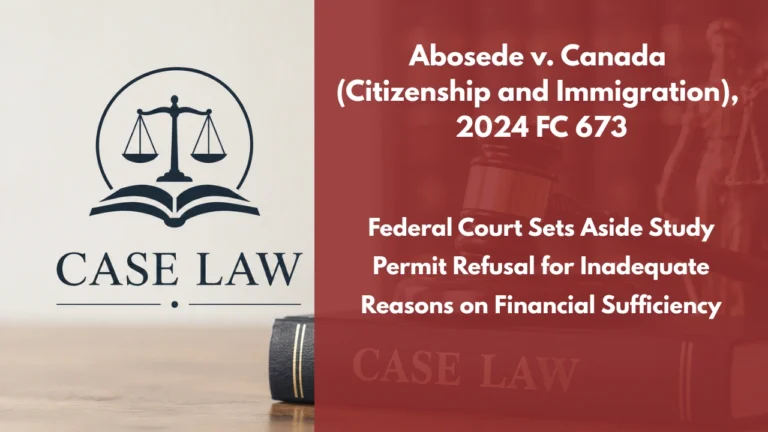
The Federal Court allowed an application for judicial review
after finding that a visa officer failed to provide adequate reasons for
refusing a study permit application on financial grounds. The applicant, a
Nigerian citizen, applied for a study permit to attend Fairleigh Dickinson
University in British Columbia. The officer refused the application under
paragraph 216(1)(b) of the Immigration and Refugee Protection Regulations (IRPR), concluding that the applicant had insufficient financial resources. The
Court held that although visa officers are entitled to assess the sufficiency
of an applicant’s finances, they must explain how and why they reached an
adverse conclusion. In the absence of intelligible reasons, the refusal could
not withstand judicial review.
Key Principle
Visa officers have broad discretion to assess whether study
permit applicants possess sufficient financial resources to support their
studies in Canada. However, even brief decisions must satisfy the principles
established in Vavilov by being justified, transparent, and
intelligible. A bare conclusion that an applicant’s financial resources are
insufficient, without explaining the underlying reasoning, is unreasonable and
cannot be supplemented by the Minister’s submissions during judicial review.
Background
The applicant, a citizen of Nigeria, applied for a study
permit to pursue studies at Fairleigh Dickinson University in British Columbia.
The visa officer refused the application solely on the basis that the applicant
had failed to demonstrate sufficient assets and financial resources as required
under paragraph 216(1)(b) of the IRPR. The applicant sought judicial
review, arguing that the refusal lacked any meaningful explanation regarding
why the financial documentation submitted was considered inadequate.
Court Findings
• Reasons Must Explain How and Why the Decision Was Made
The Court emphasized that reasons serve to explain the
decision-making process and enable both the applicant and the reviewing court
to understand why the application was refused. In this case, neither the
refusal letter nor the Global Case Management System (GCMS) notes explained
what deficiencies existed in the applicant’s financial evidence or how the
officer concluded that the available funds were insufficient.
• The Court Cannot Supplement Deficient Reasons
The Respondent attempted to defend the refusal by offering
explanations for why the applicant’s financial evidence may have been
inadequate. The Court rejected this approach, reiterating that judicial review
is not an opportunity for government counsel to supply reasons that the
decision-maker never provided. Nor may the Court speculate or make its own
factual findings to justify the officer’s conclusion.
• A Lack of Transparency Renders the Decision
Unreasonable
While acknowledging that visa officers may issue concise
reasons, the Court held that the decision still had to demonstrate a rational
chain of analysis. Because the officer simply concluded that the applicant
lacked sufficient financial resources without identifying the evidentiary
shortcomings or explaining the analysis, the decision failed to meet the
standards of justification, transparency, and intelligibility required by Vavilov.
Outcome
The Federal Court allowed the application for judicial
review, set aside the refusal, and remitted the matter to a different visa
officer for redetermination. The decision reinforces that although visa
officers enjoy considerable discretion in assessing an applicant’s financial
capacity, they must provide reasons that meaningfully explain why the evidence
fails to satisfy the statutory requirements. Unsupported conclusions, without
any discernible analysis, are insufficient to withstand judicial review.
Case Citation:
Abosede v. Canada
(Citizenship and Immigration), 2024 FC 673 (CanLII)
Prepared by:
Dr. Muhammad
Abrar (Barrister and
Solicitor)
Author | Writer | Mentor | Legal Researcher | Canadian
Immigration Case Law and Statistics Analyst