The
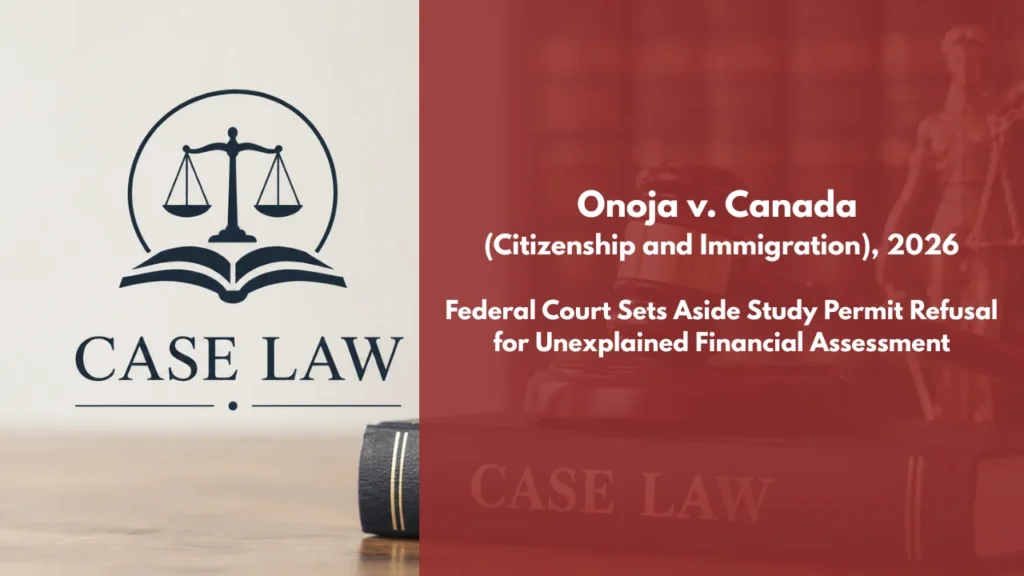
Federal Court reviewed the refusal of a study permit application filed by a
Nigerian applicant and the accompanying applications of her spouse and four
minor children. The visa officer refused the study permit on the basis that the
family had insufficient financial resources to cover tuition, travel, and
living expenses. The Court granted judicial review, finding that the officer
failed to explain how the financial evidence submitted was insufficient and
provided reasons that lacked transparency and justification.
Key
Principle
Where
applicants provide detailed financial calculations demonstrating that they meet
the required funding thresholds, a visa officer must explain why those
calculations are rejected. Conclusory findings that funds are insufficient,
without engaging with the evidence, are unreasonable.
Background
Rejoice Ojone Onoja applied for a study permit to pursue studies in Canada, while her husband and four children applied as accompanying family members. The applicants submitted financial calculations showing they believed they possessed more than enough funds to cover tuition, travel, and living expenses. The officer nevertheless concluded that the declared funds were only marginally sufficient and did not include tuition costs, resulting in the refusal of the study permit and the accompanying family members’ applications.
Court
Findings
Unexplained Rejection of Financial Evidence
The Court found that the officer’s reasoning failed
to explain how the applicants’ financial calculations were incorrect. Although
the applicants specifically outlined the required costs and demonstrated that
their available funds exceeded those amounts, the officer simply stated that
the funds were “marginal” without identifying any error in the
calculations or explaining why tuition costs were excluded. This lack of
analysis rendered the decision unreasonable.
Accompanying Family Refusals Could Not Stand
The officer also refused the accompanying family
members’ applications on the basis that they were inadmissible as accompanying
family members of an inadmissible person, despite there being no finding that
the principal applicant herself was inadmissible. While the Respondent conceded
this error, the Court found it unnecessary to determine whether the
applications could be severed because the principal study permit refusal itself
was unreasonable.
Outcome
The
Federal Court granted the application for judicial review, set aside all
refusal decisions, and remitted the applications to a different decision-maker
for reconsideration.
Case Citation: Onoja v. Canada (Citizenship and Immigration), 2026 FC 816 (CanLII)
Prepared by:
Dr. Muhammad Abrar (Barrister and Solicitor)
Author | Writer | Mentor | Legal Researcher | Canadian Immigration Case Law and Statistics Analyst