The
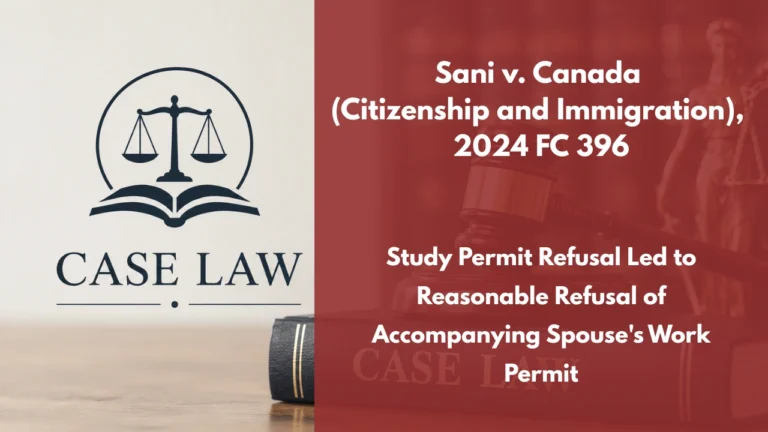
Federal Court dismissed an application for judicial review challenging the
refusal of a study permit and the related spousal open work permit. The Court
held that the visa officer reasonably concluded that the principal applicant
had not demonstrated sufficient and available financial resources as required
by section 220 of the Immigration and Refugee Protection Regulations (IRPR). Since the study permit refusal was reasonable, the corresponding
refusal of the spouse’s open work permit also stood.
Key
Principle
Study
permit applicants bear the burden of establishing that they possess sufficient
and available financial resources to pay tuition, living expenses, and
transportation costs. Although IRCC operational guidelines suggest that proof
of first-year funding may suffice in appropriate cases, visa officers retain
discretion to assess whether there is a realistic probability that funding
exists for the entire period of study. Related spousal open work permit
applications cannot succeed where the underlying study permit application is
properly refused.
Background
The
principal applicant, an Iranian citizen, applied for a study permit to pursue a
Master of Business Administration program in Canada. Her spouse simultaneously
applied for an open work permit as an accompanying spouse. The applications
included bank statements, sponsorship affidavits, evidence of real property and
other assets, and financial information relating to the applicant, her spouse,
and her father. The visa officer refused the study permit after concluding that
the available financial resources were insufficient and that the applicant
lacked significant family ties outside Canada. The spouse’s open work permit
application was refused as a consequence of the study permit refusal.
Court
Findings
•
Applicants Must Demonstrate Sufficient and Available Financial Resources
The
Court emphasized that section 220 of the IRPR requires applicants to
establish that they have sufficient and available financial resources to pay
tuition, maintain themselves and accompanying family members, and cover
transportation costs. While real property and other assets may demonstrate
overall wealth, they do not automatically constitute “available
funds” unless there is evidence that they can realistically be converted
into funds for the applicant’s education and living expenses. The visa officer
therefore acted reasonably in excluding those assets from the calculation of
available funds.
•
Operational Guidelines Do Not Override the Statutory Requirements
The
Court acknowledged that IRCC operational guidelines indicate applicants
generally need to demonstrate funding for the first year of studies and living
expenses while showing a reasonable probability of future funding. However,
those guidelines do not displace the statutory requirements contained in
section 220 of the IRPR and do not bind visa officers. Officers retain
discretion to determine whether the applicant has established sufficient
financial capacity for the proposed period of study.
•
Officers May Consider the Stability of Future Funding
Although
the Court expressed concern regarding the officer’s generalized reference to
economic instability and exchange rate fluctuations in Iran, it concluded that
this statement was not determinative. The evidence demonstrated that the
applicant had not established a reliable source of funding beyond the existing
savings available in the bank accounts. Once tuition and living expenses were
considered, there was insufficient evidence demonstrating how the applicant
would finance the remainder of her studies.
•
No Breach of Procedural Fairness
The
Court reaffirmed that study permit applications attract a low duty of
procedural fairness. Visa officers are not required to issue a procedural
fairness letter or request additional documentation where their concerns arise
directly from the statutory requirements and the evidence submitted by the
applicant. The officer’s concerns related to the sufficiency of the financial
evidence rather than the credibility or authenticity of the documents, and
therefore no additional opportunity to respond was required.
Outcome
The
Federal Court dismissed the application for judicial review, finding that the
visa officer reasonably concluded that the applicant had failed to establish
sufficient and available financial resources under section 220 of the IRPR.
Because the study permit refusal was reasonable, the related refusal of the
accompanying spouse’s open work permit also remained valid. The decision
confirms that applicants bear the burden of demonstrating not only immediate
financial capacity but also a realistic probability of funding throughout the
proposed period of study.
Case
Citation:
Sani v. Canada (Citizenship and Immigration), 2024 FC 396 (CanLII)
Prepared
by:
Dr. Muhammad Abrar (Barrister and Solicitor)
Author | Writer | Mentor | Legal Researcher | Canadian Immigration Case Law and
Statistics Analyst