The
Federal Court dismissed a judicial review of the refusal of a spousal open work
permit application under the International Mobility Program. The applicant
argued that his spouse’s unconditional letter of acceptance into a
post-graduation work permit (PGWP)-eligible program was sufficient to establish
eligibility. The Court held that the visa officer reasonably concluded the
application had been filed too early because the applicant’s spouse had not yet
enrolled in or begun full-time studies.
Key
Principle
For
a spousal open work permit based on an international student, an acceptance
letter alone does not establish eligibility where the principal applicant has
not yet enrolled in or commenced full-time studies in a PGWP-eligible program.
Applicants bear the burden of demonstrating that all eligibility requirements
have been met at the time the application is assessed.
Background
The
applicant’s spouse was initially admitted to an English language program before
receiving an unconditional letter of acceptance into a one-year Human Resources
Certificate program beginning several months later. After the first spousal
open work permit application was refused, the applicant reapplied using the
unconditional letter of acceptance.
The
visa officer refused the second application, concluding that although the
spouse had been accepted into a qualifying program, she was not yet studying or
enrolled in full-time studies at the time of the decision and therefore the
applicant was not yet eligible for a spousal open work permit.
Court
Findings
•
An Acceptance Letter Does Not Establish Eligibility
Justice
Roy held that the officer reasonably distinguished between receiving an
acceptance letter and actually being enrolled in or actively pursuing a
PGWP-eligible program. The unconditional letter of acceptance alone did not
satisfy the applicable eligibility requirements.
•
The Application Was Filed Prematurely
The
Court agreed with the officer’s conclusion that the applicant had applied too
early. At the time of the decision, the spouse had not yet begun her full-time
program and there was no evidence demonstrating she was enrolled or actively
engaged in qualifying studies. Accordingly, the officer reasonably determined
that the applicant was not yet eligible for a spousal open work permit.
•
No Procedural Fairness Breach Occurred
The
Court rejected the applicant’s procedural fairness argument arising from the
officer’s request for an original acceptance letter. Requesting additional
documentation did not deprive the applicant of any participatory rights, and
the officer fully considered the acceptance letter before concluding that it
did not establish eligibility.
Outcome
The
Federal Court dismissed the application for judicial review, confirming that
the refusal was reasonable. The decision reinforces that applicants seeking a
spousal open work permit must establish that the principal applicant is
enrolled in or actively pursuing eligible full-time studies, and that an
acceptance letter alone will not satisfy this requirement.
Case
Citation:
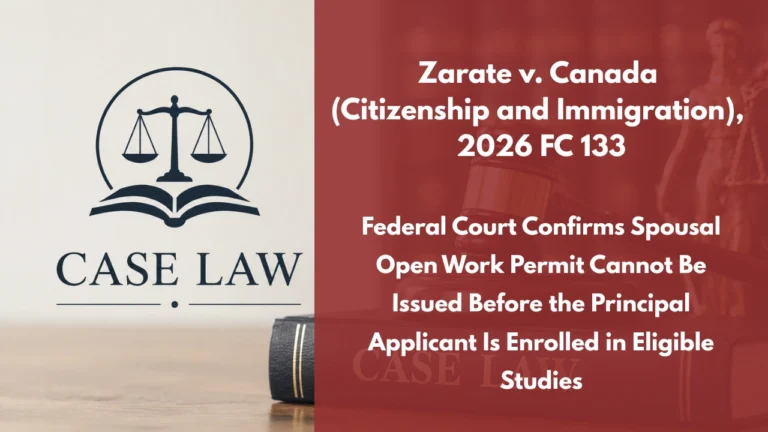
Zarate v. Canada (Citizenship and Immigration), 2026 FC 133 (CanLII)
Prepared
by:
Dr. Muhammad Abrar (Barrister and Solicitor)
Author | Writer | Mentor | Legal Researcher | Canadian Immigration Case Law and
Statistics Analyst