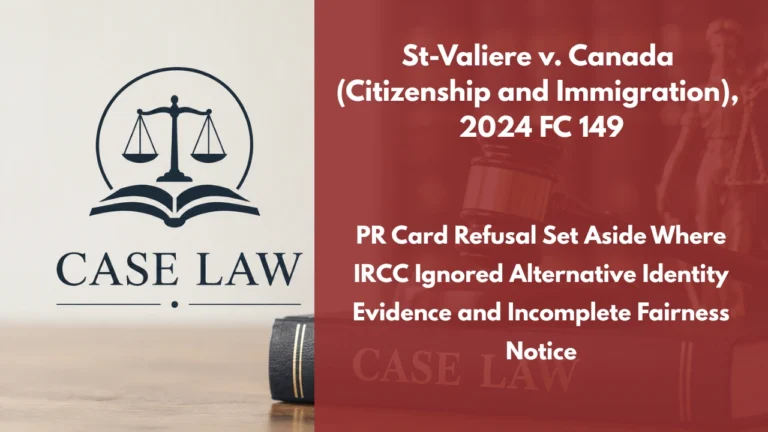
The Federal Court reviewed IRCC’s
refusal of Natacha Noel St-Valiere’s application for a new PR card. IRCC found
that she had not provided a primary identity document. The Court granted
judicial review because the reasons failed to address the regulatory
alternative available to applicants who cannot obtain conventional identity
documents and because the procedural fairness letter did not identify all
alleged deficiencies.
Key Principle
An applicant
who lacks a passport or other primary identity document may rely on alternative
identity evidence permitted by the regulations. IRCC must determine whether the
statutory declarations and accompanying explanation satisfy those requirements
and provide intelligible reasons for its conclusion. When IRCC sends a
procedural fairness letter, it must identify all documentary deficiencies the
applicant is expected to remedy.
Background
The applicant became a PR in 2006
and applied for a new PR card in 2021. She submitted a statutory declaration
confirming her identity and another declaration from her former spouse, who had
known her before she entered Canada.
She also explained that mental
health difficulties and hospitalization affected her ability to obtain identity
documents. IRCC nevertheless refused the application for failure to provide a
primary identity document.
Court Findings
• Regulations Provided an
Alternative to Primary Identification
The governing provisions allowed
an applicant without a conventional identity document to submit alternative
documentation. This could include the applicant’s statutory declaration and a
declaration from a qualifying person who knew the applicant before entry,
provided the required explanation was also established.
• Applicant Submitted the
Required Statutory Declarations
The applicant supplied her own
declaration attesting to her identity and a second declaration from her former
spouse. IRCC’s reasons did not acknowledge these documents or explain why they
failed to satisfy the alternative identity framework.
• Reasons Failed to Address the
Applicant’s Explanation
The applicant provided an
explanation concerning her mental health and hospitalization. Although the
explanation may not have been sufficiently connected to conditions in her
country of nationality, IRCC never analyzed that issue or explained what specific
element was missing.
• Respondent Could Not Rely on
New Refusal Grounds
The Minister argued that the
applicant had not properly addressed the loss of her previous PR card. However,
IRCC’s decision relied only on the identity-document requirement, and the
application form showed that she had completed the section concerning the lost
card.
• Procedural Fairness Letter Was
Incomplete
IRCC’s letter instructed the
applicant to submit a passport, certificate of identity, or travel document. It
did not advise her that the alternative explanation was deficient or that
additional country-related evidence was required, depriving her of a meaningful
opportunity to complete her application.
• Decision Did Not Show All
Available Criteria Were Considered
The refusal stated only that no
primary identity document had been provided. Because the reasons were silent on
the alternative regulatory route, the Court could not determine whether IRCC
considered it, misunderstood its applicability, or overlooked the submitted
evidence.
Outcome
The Federal Court granted
judicial review and returned the PR card application to a different
decision-maker for redetermination. IRCC could issue another fairness letter if
additional information was required. No question was certified.
Case Citation:
St-Valiere v. Canada (Citizenship and Immigration), 2024 FC 149 (CanLII)
Prepared by:
Dr. Muhammad
Abrar (Barrister and
Solicitor)
Author | Writer | Mentor | Legal Researcher | Canadian Immigration Case Law and
Statistics Analyst